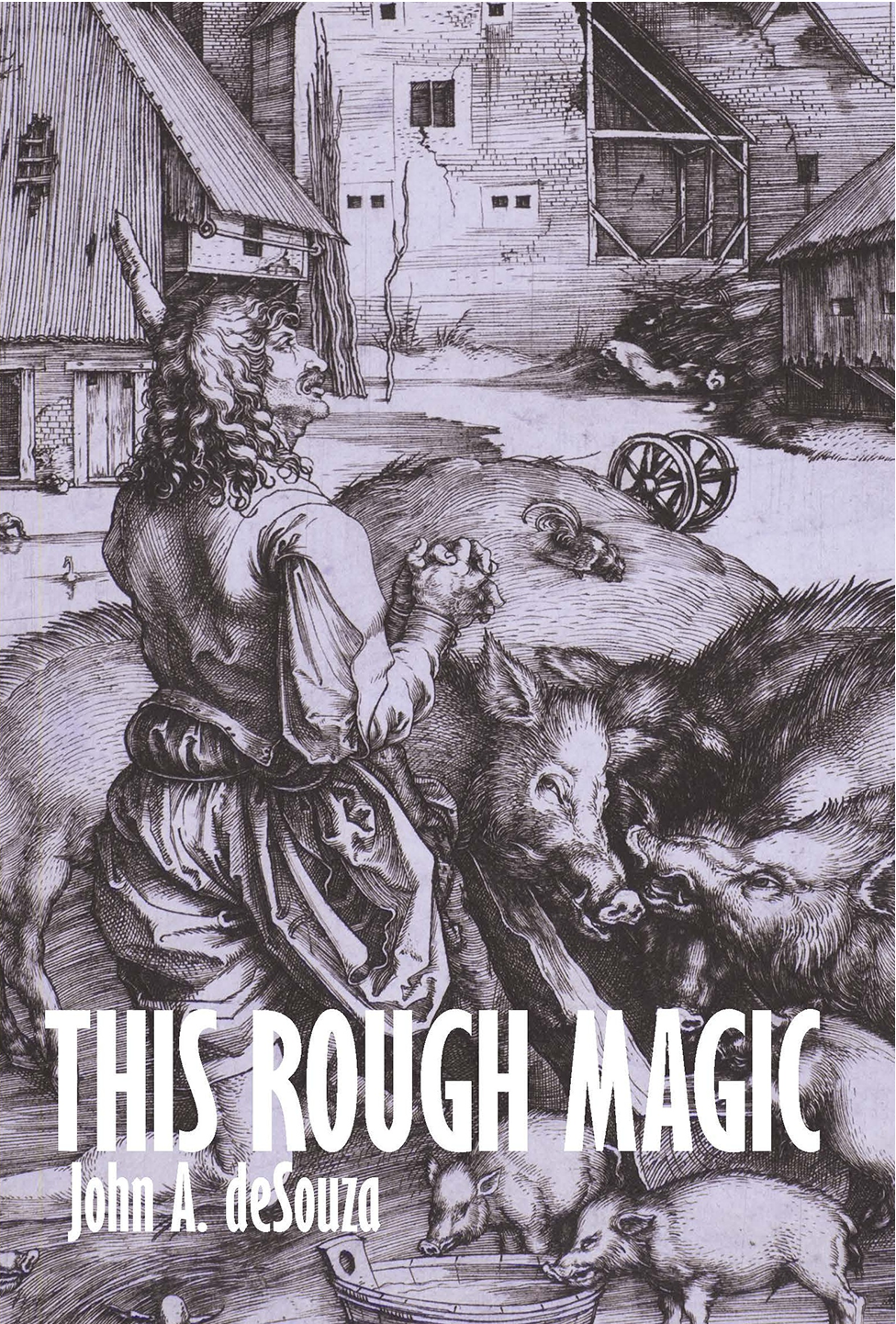
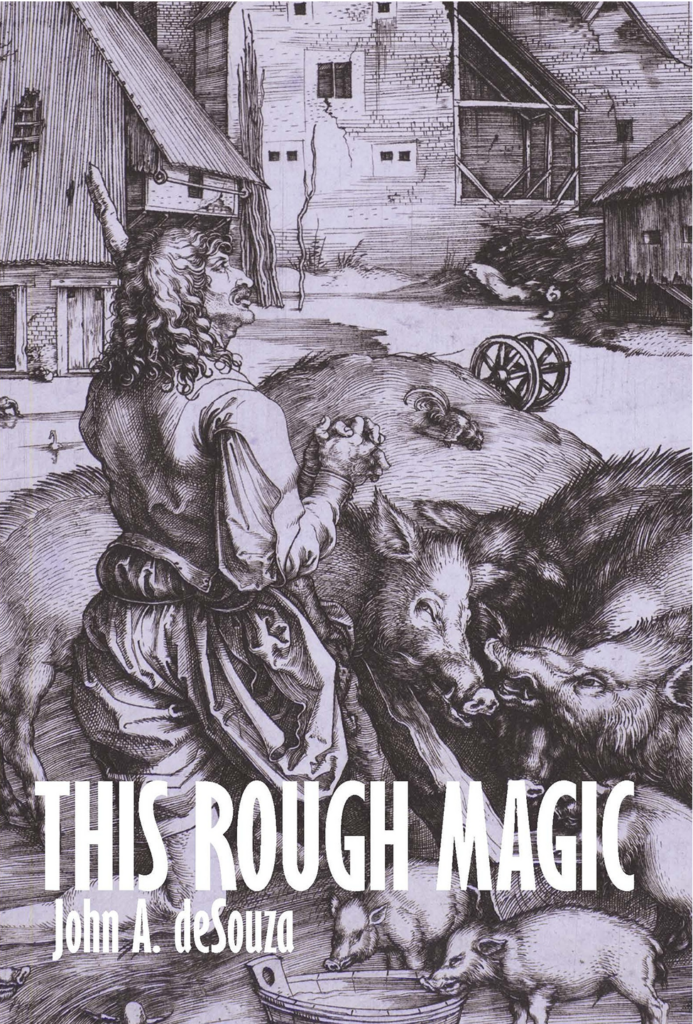
I first encountered John A. deSouza in 2025 when he submitted poetry to the literary magazine I run called the engine(idling. I found his style to be fascinating, memorable, and seemingly effortless. His voice was enchanting. When John asked me to write a blurb for his chapbook from Rockwood Press, This Rough Magic, I happily sang the book’s praises for him. Around the same time, I volunteered to try out the role of PCR’s Interviews Editor. Seeing John’s book on the list for potential interviews, I jumped at the chance to pick his brain.
deSouza writes his poetry in Jersey City, NJ, where he lives with his wife and their terrier, Mr. Darcy. Though his first poetry chapbook, Hidden, a sequence of poems addressing the war in Ukraine, was published only last year, he’ll have four chapbooks published by the end of 2026, including This Rough Magic, one from Bainbridge Press called Labyrinth, and one from Finishing Line Press called In the Garden. His first full-length poetry collection, Concord Ave. Georgics, is forthcoming from Broadstone Books in 2027.
Editor’s Note: The following collaborative interview was conducted by email in March, 2026. It has been edited for length with the consent of the interviewee.
Could you start by telling readers a little about the title of your collection, This Rough Magic? What made you choose it, and a little about its allusion to Shakespeare?
Yes, of course. The title is an allusion to Prospero’s famous lines from Shakespeare’s The Tempest, which begin Act V, where he declares: “But this rough magic I here abjure….” I believe that an aging Shakespeare clearly draws parallels between Prospero and his own life, of which we have so little biographical detail, making the play a tantalizing window into a kind of poetic autobiography the key accomplishment of which, perhaps, culminates in acceptance and forgiveness.
But what is meant by “rough magic,” and what does the old Duke “abjure” as he breaks his staff and buries his book? Since losing my father last year as he approached 90, such questions have taken on a greater significance. Language is a powerful tool and can do great harm both to ourselves and to those most close to us when used cruelly or selfishly. Speaking and thinking in harmful ways can easily become a punishing habit of mind and can be a difficult one to break as life moves quickly forward.
These poems seem to draw from a deep well. What has influenced and/or informed your poetry? Was there a particular catalyst that drove your writing?
I’ve always been a person that required a creative outlet. As a child and teen it was drawing and art. I could draw for hours without any sense of time passing. There was a quite popular children’s poetry anthology when I was a kid by Louis Untermeyer called The Golden Treasury of Poetry. The nice thing about this anthology, though aimed at a younger readership, is that all the poems were by the greats like Keats, Dickinson, Hopkins, e.e. cummings, etc. The section titles were equally inviting to a child, with names like “Creatures of Every Kind” and “Wide Wonderful World.” In this way, reading poetry became an extension of reading fairytales for me. It was a kind of natural progression. Later, I would read widely in Untermeyer’s anthologies for adults: Modern American and British Poetry, as this was what could be found on our shelves at home.
As a teen, I was accepted into an afterschool poetry workshop called “The Dream Class,” taught mainly by the Canadian poet Christopher Dewdey in downtown Toronto where I grew up. Various poets that published with Coach House Press, and I think House of Anansi Press, came through to give a little talk. People like Michael Ondaatje, who I was quite taken with then because of some of his short books like Coming Through Slaughter and Billy the Kid, which were wildly inventive and experimental, and to me very exciting.
This chapbook is specifically infused with grief, as I lost my father just last October, and am still finding my way through that maze.
At university, I just sort of hung on for nine years and studied widely. Eventually, the Provost’s office found a way to encourage me to graduate with a BA in English, though I had wandered all over the place. I should also mention how very grateful I am for our small community of passionate and talented people who love to read and write poetry. Look hard enough and you will always find like-minded individuals. I have always encountered this amazing community of people without whom I’d still be like that odd little boy reading on the carpet in my suburban childhood home.
Could you tell readers about the authors you like to read, what you admire about them, and how they might inform or inspire your own writing?
Something I learned from John Ashbery—who I knew as more of a poetry acquaintance through an older friend when we lived in Princeton—was to be interested in absolutely every kind of poetry you could find. He had an insatiable curiosity, a hunger, for new and original forms of expression. As you also know well, technology has allowed for an explosion of writing and publishing, which is really the most amazing thing. People are fascinating in the multitude of ways they choose to use language. I think, again, you have to love to read poetry to be a halfway decent poet, otherwise your field of reference becomes pretty limited and your language pretty hackneyed.
As you can imagine, I love Ashbery’s writing and have for a good 25 years. I think everyone who loves poetry should be familiar with his selected volumes, The Mooring of Starting Out (Ecco, 1997) and Notes From Air (Ecco, 2007), which are incredibly rich, and just the tip of the iceberg. I’d argue that his book of prose poems, Three Poems (Penguin Books, 1972), is one of the great poetic works of post-war writing. I think of Ashbery in the same space as Pope and Shakespeare—someone comfortable with all registers of language and able to use them with unrivaled precision. But we can’t let the poets we love overwhelm our own voices.
I have certainly learned things from Ashbery that I rummage for in my tool box. This is the same for many poets, for example: Sylvia Plath for her minutely crafted lines; Wallace Stevens’ musical philosophy of the mundane and his inexhaustible playfulness and humor; Dickinson’s concision and spry implication; Keats’ musicality, coupled with a brilliance of discursive thought, (sadly overlooked due to his use of sometimes well-worn adjectives); John Donne’s intimate and playful love sonnets with their tinge of profound faith and brilliant use of extended metaphor.
I love equally to listen to the songs of Bob Dylan or hip-hop verses of Kendrick Lamar, who I most definitely consider a poet in the same way he has found his own voice and language to talk to his personal experience and make it stand for something much larger.
Many of your poems deal with themes of profound grief, loss, and love. How do you find balance between the personal and the artistic? Did you find yourself needing to pull back emotionally?
I think so many poets take for granted that poetry is about feelings, and certainly there is a place for emotion in lyric composition. This chapbook is specifically infused with grief, as I lost my father just last October, and am still finding my way through that maze. I think, for me, writing poems is often about trying to solve a problem or answer a question. Something happens in the process of writing that suspends the emotion in question, gives it a kind of new life but also a distance that is observable. Then, finally, in sharing the finished poem I imagine it creates a kind of bridge to others, struggling with similar emotions, and I think there’s some relief in that for both the poet and the reader, a kind of Keatsian “warm and extended hand” held, if you like. Unfortunately, we learn how loss becomes increasingly present with age, though it has always been there with us in some manner, even when young.
Many of the poems are an attempt to safeguard the times and experiences that mean the most to me, and the moments of intense feeling these invoke, especially of love, in all its complexity. I saw these kinds of poems as an important counterweight to the grief and loss of the others in the collection. Passionate love is one thing and always fun to write about, especially when we are young and falling into it—which of course can happen any time—but I think of more importance to my writing is the love of acceptance we grow into with each other, with lovers, spouses, family members, children, friends, all the people we cherish.
In poems like “Winter’s Midnight,” we see you turn to the natural world like a totem. How much of a role would you say nature plays in this collection, and in your writing, generally?
I think an unorthodox but intriguing way of reading a poem for meaning, and putting the captivating music of it aside for a moment, is reading it in reverse. When I look at “Winter’s Midnight” in this manner, the totemic aspect of nature you refer to jumps out at me as a kind of sacred lover, that even in the midst of the coldest pit of winter, one can still imagine nature as vibrant lover, alive and blossoming again.
Nature is enormously important to me and is everywhere in this collection and in my writing. I have been fortunate in having lived a life that balances urban and rural environments. My childhood summers were spent at camp in the pristine wilderness of Ontario’s Algonquin Park, and at a family cottage along the St. Clair River across from Michigan.
Language is a powerful tool and can do great harm both to ourselves and to those most close to us when used cruelly or selfishly.
My family owns an island in East Bay Lake Muskoka, also exquisitely beautiful country. Even though we live in a dense urban center in Jersey City, we are easily within 50 miles in any direction from where you can encounter great natural beauty. My mother’s home is just within the most beautiful Connecticut woods above Cos Cob.
In this poem, an important aspect I had in mind is the role of the Greco-Roman myth of Proserpina, Dis, and Ceres, here largely derived from Virgil and Ovid. So in that sense Nature has a very real, albeit literary, totemic aspect in the form of a classical Goddess awaiting freedom in Death’s Underworld prison, and yet this overlaps with a very real moment one night walking my dog in which I suddenly remembered the gardens up and down the street as they were that past summer.
Your writing comes across as very natural on the page. Can you tell readers a little about your creative process? For example, how much of your work is measured and how much is spontaneous? Are you chasing down forms, shapes, and sounds in your poetry or are you just letting the words flow?
I think discipline is everything when it comes to achieving a natural feeling in any kind of art. The goal is always the kind of mastery that allows for inventive creative play and expression. For this to appear natural I think there must be a lot of artifice behind it, which is not to say I don’t leave room for happy accidents.
I get up every day, make my wife tea, walk our terrier, Mr. Darcy—all the mundane aspects of a life I imagine most of us live every morning in some manner. But these things finished with, and well into a strong cup of coffee, I sit down around 10:00 every morning and write a poem. Sometimes this comes with amazing alacrity and others slowly, haltingly. With age and practice, the writing now comes mostly of its own internal momentum without me having to interfere too much with it. It follows its own logic in terms of form and development.
Writing poetry for me takes an enormous amount of mental effort, done mostly during the other hours of the day that I am not writing, but which are occupied with trying to think something through, or see how disparate things may connect. I am a firm believer in threes—that is, combining three disparate things. This takes you out of the usual A-to-B binary logical progression, which I think can leave so much out. I think there’s a lot of magic to be found in the space that third aspect often opens for me.
Poems like “The Blink of an Eye” and “Nostalgia” focus on memory and reflection, but one can also feel in your words a bit of a push toward mindfulness of the present. Do you consider your poetry to be genuinely nostalgic or are you pushing against that notion of romanticizing the past?
Now this is a difficult question about two difficult poems, which I think capture a lot about my attitude towards memory, nostalgia, and being grounded in the present. I think it would be inhuman to live without some kind of nostalgia, as a kind of means of mythologizing the past, which is a comfort to us in the way a familiar bench in a park or garden may be. For me, yes, the garden has a kind of nostalgic pull, but I think the basis for the nostalgia is correct precisely because it was a place that grounded me in the present moment and helped me to see how the past—the broad historical past and my own past—intersect in the present moment.
I think it’s easy to get caught up with past mythologies and grant them excessive weight in the way we interpret personal experience. In my poems, I spend a lot of time questioning assumptions, and that extends equally to questioning the mythologies we are currently constructing—say, with our reliance on technology and science. We have gained so much understanding through science, and technology has allowed us to connect in new and exciting ways and yet there remains something sterile and unlived about technology. The mythologies, what we believe in to help explain the world around us, do not fundamentally change the way we experience the very human aspects of living. I think this has always been the case and always will, no matter how the reality between each other is mitigated by imperfect systems. So what I’m getting at is that it’s still very important to listen for the “singsong spell of now,” and to try to be aware of where one’s mind and thinking is in the moment.
Can you talk a little about what the compilation and publishing journey was like for This Rough Magic?
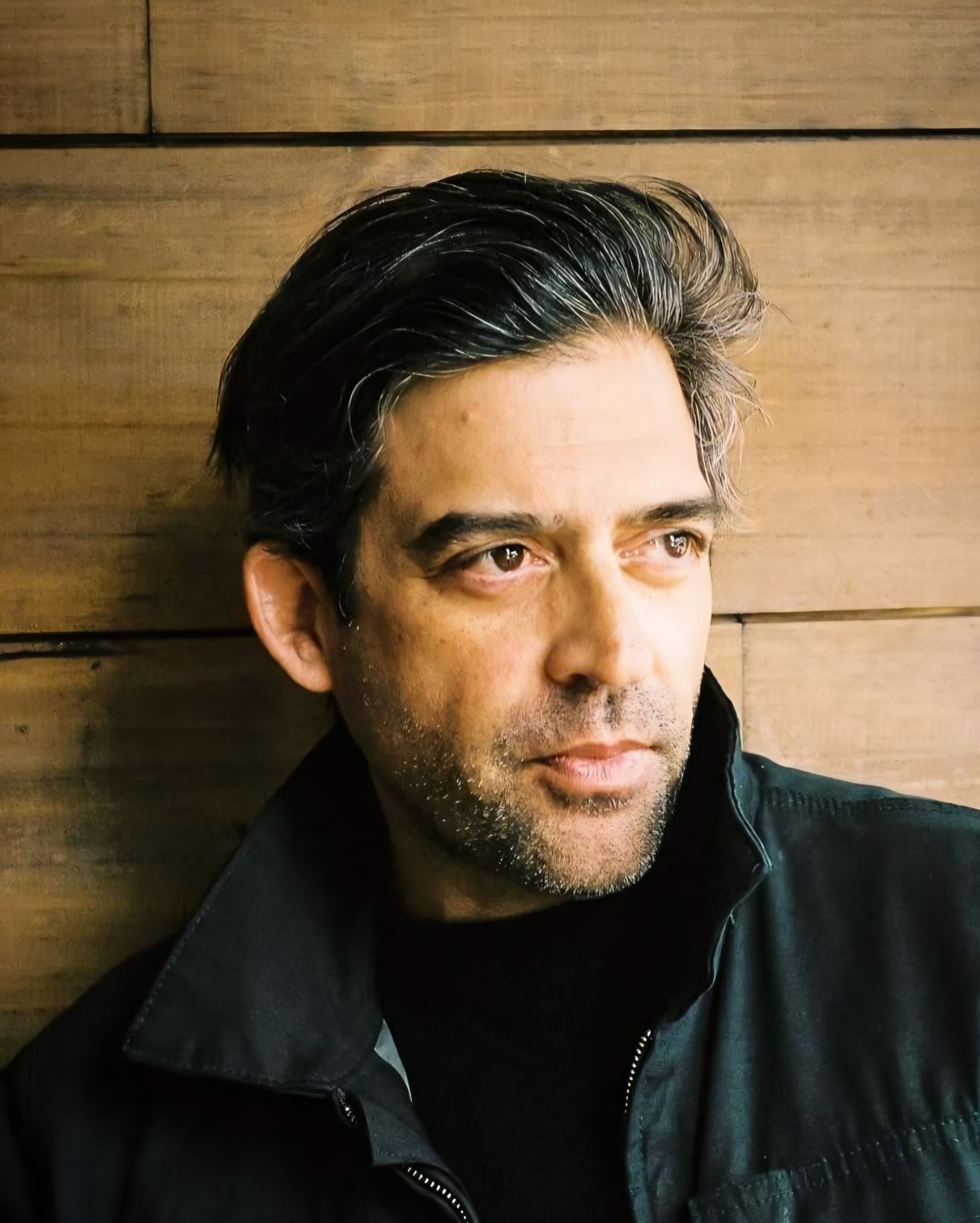
Photo: Dan Bassini
In the end, This Rough Magic happened in a completely spontaneous and rapid kind of way. My father passed late October last year, just shy of his 90th birthday, after several decades of fighting heart disease. He had several near-death visits to the ER/ICU over the years, which are documented in poems like “Prodigal” and “The Old Gods.” In the wake of his loss, my writing took a pretty sharp turn into examining our sometimes-fraught relationship, including how we both tried to patch things up, to forgive and accept each other’s failings. So the selection, and new composition, became pointedly impacted by loss and grief, yet only seven of the poems in the collection were written in November and December of last year. The amazing thing about this collection was how it seemed to collect itself, according to some mysterious focus of mind under the pressure of my grief. There are many poems in the chapbook that were written at various times over the past decade: poems about my father and I, poems about love and relationships, poems, as we’ve discussed, about memory and nostalgia, and poems that attempt to replicate how my mind addresses such questions.
The selection and arrangement was not dissimilar to the way the actual writing of poems happens for me as something external to myself, or from a part of myself that I struggle to control. Some of the poems had already been picked up by journals, and I think this is a nice way to validate your work when submitting it as a manuscript to editors at presses. The really amazing thing was that I sent the manuscript out on January 1st of this year to a dozen or so publishers, and five days later this really terrific editor, Eric Muhr of Rockwood Press sent me an acceptance. I was elated at the quick turnaround, and impressed as our interactions unfolded with how personally committed Eric was to getting everything right in order to finalize the copy, layout, and cover art. I am so grateful for the time he took to work through my own many oversights in order to get it all just right. No easy task.
Will there be any events, like readings, for this book? Where else can we find your recent poetry? Can you tell readers about what’s next or what you’re working on now?
The last two years have been a huge learning curve for me with regard to publishing, which in the end has gone pretty well. You just have to persevere. In this span, I’ve managed to publish close to 40 poems in a wide variety of journals, and another 90 across four chapbooks, Hidden (Bottlecap Press), This Rough Magic (Rockwood Press), and two others, just recently accepted, In the Garden (Finishing Line Press), a subset of poems from my larger collection Concord Ave. Georgics, (Broadstone Books, 2027), and Labyrinth, the middle section of the same work (Bainbridge Island Press).
Yes, I am in the process of seeking reading venues and issuing a press release to local media outlets interested in culture in Jersey City, Hudson County, and the surrounding area. I’m grateful to Philly Chapbook Review for making this interview available which should be a great resource for people who want more information about me or my chapbook. I’ve been working on a website, but in the meantime those interested in finding my work can go through linktr.ee/JAdPoetry, specifically my Facebook writer’s page.
What do you hope readers will take away from This Rough Magic?
Not all the poems were written in the shadow of grief. Some had been completed previously, but suddenly found their place in a newly balanced arrangement that I hope provides a broader experience for the reader, so that they may also see loss in terms of an aspect of life which deepens one’s understanding and acceptance of others. I like the image, below, from “Togetherness” of a life lived that both contains one and then opens, that has a kind of life that inhales memory and exhales emotion, even from middle age to childhood and back again. I hope readers take away a deepened sense of such moments in their lives and will pause and think about what they mean to themselves and each other.
These persistent habits get rooted in a mood like a closed room.
What spreads from the corners? What were we solving?
The mobile twists above, color fades again behind a cloud.
John A. deSouza is the author of Concord Ave. Georgics (Broadstone Books, forthcoming 2027) and four chapbooks: Hidden, a sequence of poems addressing the war in Ukraine (Bottlecap Press), Labyrinth (Bainbridge Island Press), This Rough Magic (Rockwood Press) and In the Garden (Finishing Line Press, forthcoming). He was shortlisted for the Letter Review Prize for Unimaginable Hardship, poems for Ukraine (2024). John has recently been featured in Poetry Salzburg Review. His poem, “Prodigal,” has been nominated for a 2025 Pushcart Prize. He has upcoming poems in The Dalhousie Review, The Courtship of Winds, and Abstract Magazine.
John is a graduate of the University of Toronto with a B.A. in English and has been a resident of Jersey City for over a decade where he lives with his wife, Oksana, whose family is of Ukrainian origin.
About the Contributor
Danielle McMahon is Interviews Editor and a Poetry Reader for Philly Chapbook Review, as well as the author of four poetry chapbooks and two micro-chaps. Most recently, her micro-chap rowhouse song was part of the 2025 Ghost City Press Summer Series. Her latest chapbook irl is now available from Stanchion Books. She is also the Editor of the engine(idling.
Contents
Chapbook Poem: Slow Burn by Evan Wang
“The concept of personifying a slow burn deeply resonated with who I thought myself to be—a slow burn, love flickering around me.” Read the featured Chapbook Poem of the Month for April 2026, “Slow Burn” by Evan Wang, along with a few words from the poet.
Book Excerpt: She wants shimmering scales by Nicole Alston Zdeb
“The nexus of the erotic, the social, and the body felt relevant to what I was experiencing at the end of the 20th Century. There are glimmers of personal lore as well…” Read the featured Excerpt Poem of the Month for April 2026, “She wants shimmering scales” from The End of Welcome by Nicole Alston Zdeb, along with a few words from the poet.
“I wanted to explore how time was registered not only by the calendar and clock, but also in the various utilitarian tasks of my mother’s life.” Read three poems by Ron Mohring, our first biweekly poet of the Spring 2026 issue, along with a few words about “Fuse.”
Three Poems by Andrew Pelham-Burn
“Children in these circumstances are deprived of love at a formative stage and learn to immediately behave like adults without the benefit of the learning path of childhood.” Read three poems by Andrew Pelham-Burn, our second biweekly poet of the Spring 2026 issue, along with a few words about “Conkers.”
A Conversation with John deSouza
“Language is a powerful tool and can do great harm both to ourselves and to those most close to us when used cruelly or selfishly.” Poet John deSouza discusses his chapbook, This Rough Magic, his creative process, and the influence of John Ashbery in this interview with editor Danielle McMahon.
Chapbook Poem: from Stray Hunter’s Bullet by Lance Le Grys
“…what interested me was the idea of a character who didn’t do what he was capable of, not because of external circumstances, but because of either a lack of will or a seemingly perverse one.” Read the featured Chapbook Poem of the Month for May 2026, from Stray Hunter’s Bullet by Lance Le Grys, along with a few words from the poet.
Book Excerpt: Love does not exist by Maria Giesbrecht
“This poem was inspired by a dream… I had this strange feeling when I woke up that it meant something more and started writing a poem to see if anything would reveal itself to me.” Read the featured Excerpt Poem of the Month for May 2026, “Love does not exist” from A Little Feral by Maria Giesbrecht, along with a few words from the poet.
“After a loss in my family, I discovered one grieves for both the living who hide their pain and for the dead who sleep in silence.” Read two poems by Patricia Wallace, our third biweekly poet of the Spring 2026 issue, along with a few words about “Fox.”
May ’26: New Staff, New Calls, New(ish) Name
Editor Aiden Hunt provides information about changes to PCR’s name, format, and staff in this editor’s note, which also contains links to our Spring calls for submissions.
“I kept thinking about how easily adults learn to stop seeing what’s right in front of them, especially when they’re somewhere between one country and another, neither arriving nor leaving.” Read four poems by Nivara Lune, our fourth biweekly poet of the Spring 2026 issue, along with a few words about “Notes Toward an Elsewhere.”
The Lines of Landscape: on The Catastrophes by Marie Scarles
“Scarles’ choice of title points away from place, and toward the book’s deeper and more powerful offering: a changed way of seeing, one of the hallmarks of any successful poetics.” Read the full chapbook review by contributing editor, D.W. Baker.
“Every time I plucked a few of the little orange sun sugars to take inside, their garden smell lingered on my fingers. It was almost enough to just sit with that scent…” Read three poems by Kait Quinn, our fifth biweekly poet of the Spring 2026 issue, along with a few words about “The Tomato.”
Chapbook Poem: Superbloom by Joyce Schmid
“That June, flowers bloomed everywhere in Northern California—as if to honor her, to celebrate her life. This poem is an attempt to accept the fact that she is really gone.” Read the featured Chapbook Poem of the Month for June 2026, from Superbloom by Joyce Schmid, along with a few words from the poet.
Book Excerpt: The Well by Robin Becker
“Allowing flickering sentiments and images to play against one another, I replicated one form of consciousness. A surprising aspect of the poem: the sudden appearance of figures of government.” Read the featured Excerpt Poem of the Month for June 2026, “The Well” from Midsummer Count by Robin Becker, along with a few words from the poet.
“Like a lot of my poems, this one reaches toward something impossibly out of grasp. But … maybe that’s the power of a poem, to momentarily touch something out of our reach.” Read three poems by Scott Weaver, our sixth and final biweekly poet of the Spring 2026 issue, along with a few words about “Annotating The Inferno.”
A Conversation with Abby Minor
“[A] long time ago I realized, and more or less accepted, that I would commune with most of my poet teachers and comrades via their work, not in person. And my work is how I talk to them.” Poet Abby Minor discusses her chapbook, Infinity Ballot, her Jewish-Appalachian heritage, and her convictions in this interview with new contributor, Julie Swarstad Johnson.