Philly Poetry Chapbook Review is pleased to present three original poems by Andrew Pelham-Burn as our second biweekly featured poet of the Spring 2026 issue.
Poems
Caller
It was as if Goodbye took
shape and walked into that
room, took off her coat and
settled into the armchair
beside the fire. Who could
blame her? It was cold outside
with the grass already brittle,
dusted white in the moonlight.
If you were not sleeping so
peacefully you would have
welcomed her into your
home, as you always did
to friends and strangers.
“Will you have a cup of tea?”
and “I’m sure we have some
biscuits.” But Goodbye had
no thirst or hunger. She just
sat patiently, quietly waiting
to take you by the hand and
lead you into the night.
Conkers
How quickly we wanted to age
them. Take their gleaming, newborn
form peeled fresh from a green-spiked
mace-like pod. Bake them, soak them
in vinegar until the skin dulled and
wrinkled. When they were hard as
stone they could be pitted against
the others. We grew before our time,
pushing against the slow pace of years
thirsting to be grown. Mentored by
those privileged to wear long trousers,
their scabbed knees covered in thick
grey cord. Little men whose pockets
bulged with new brown conkers.
Was There Poetry
“What cannot be said will be wept.” ― Sappho
Was there poetry when Moria burned1
Was there the sweet sound of a lyre
when the wind worried the tent flaps
or song as gales fanned the flames
From fragments elegiac lines tell
us of love and family but unrequited
passion for the ferryman is told only
by the missing
On another island at another time
hymns were sung under Slievemore as
soup was ladled into wooden bowls
no homes to take them to
Between charred and abandoned shacks
music flows like scent and we remember
there must have been laughter humanity
locked within the ruins
“someone will remember us I say even in another time”
― Sappho, If Not, Winter: Fragments of Sappho
- On September 8, 2020, fire destroyed Moria Reception and Identification Centre on the Island of Lesbos, leaving more than 12,000 asylum seekers without shelter. ↩︎
About “Conkers”
‘Conkers’ was written in response to being sent to an English Boarding School for ten years from the age of eight. The experience had a profound effect on my emotional and psychological upbringing, a trauma now recognised as Boarding School Syndrome. Children in these circumstances are deprived of love at a formative stage and learn to immediately behave like adults without the benefit of the learning path of childhood.
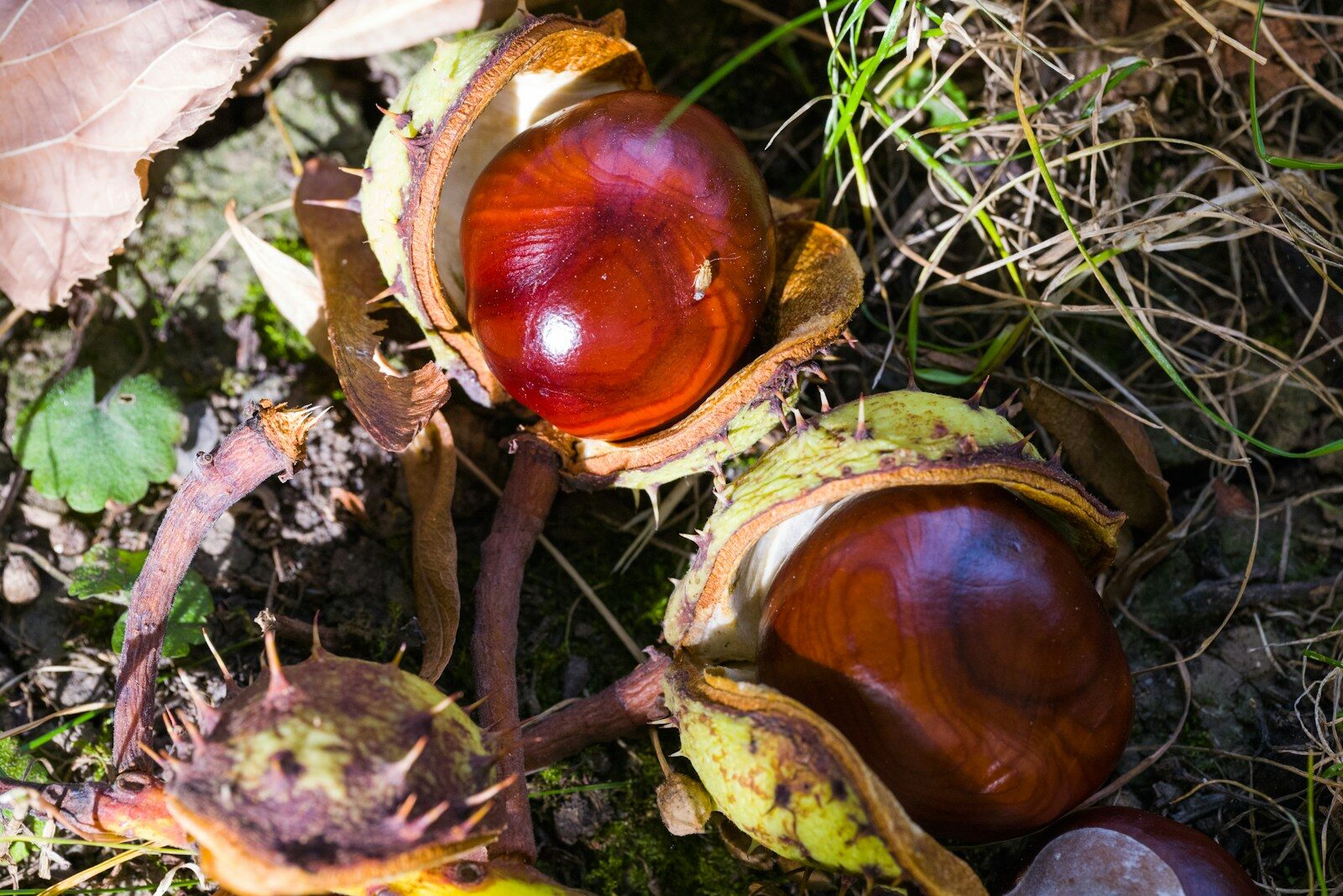
Conkers is a game that children played using nuts (Buckeyes) from Horse Chestnut Trees. Competitors would try to smash their opponent’s conker with their own. It was highly competitive and children used many secret methods to harden their conkers and become champions. Playground reputations could be gained or lost with the swing of a conker.
Senior boys in the school were allowed to wear long corduroy trousers; the remainder of the boys would be in shorts and long socks resulting in blue knees because of the cold.
Author Bio
Andrew Pelham Burn recently completed an MA in Writing at The University of Galway. His poetry has been published in The Cormorant Broadsheet and The Cormorant Anthology, Scrimshaw, Ropes Literary Journal, New Irish Writing in The Irish Independent, and Stony Thursday Book. He has won the Goldsmith Festival Poetry Competition and was shortlisted for the Cúirt New Writing Prize. He lives in the West of Ireland and was a cheesemaker for over fifteen years before taking up writing full time.
Contents
Chapbook Poem: Slow Burn by Evan Wang
“The concept of personifying a slow burn deeply resonated with who I thought myself to be—a slow burn, love flickering around me.” Read the featured Chapbook Poem of the Month for April 2026, “Slow Burn” by Evan Wang, along with a few words from the poet.
Book Excerpt: She wants shimmering scales by Nicole Alston Zdeb
“The nexus of the erotic, the social, and the body felt relevant to what I was experiencing at the end of the 20th Century. There are glimmers of personal lore as well…” Read the featured Excerpt Poem of the Month for April 2026, “She wants shimmering scales” from The End of Welcome by Nicole Alston Zdeb, along with a few words from the poet.
“I wanted to explore how time was registered not only by the calendar and clock, but also in the various utilitarian tasks of my mother’s life.” Read three poems by Ron Mohring, our first biweekly poet of the Spring 2026 issue, along with a few words about “Fuse.”
Three Poems by Andrew Pelham-Burn
“Children in these circumstances are deprived of love at a formative stage and learn to immediately behave like adults without the benefit of the learning path of childhood.” Read three poems by Andrew Pelham-Burn, our second biweekly poet of the Spring 2026 issue, along with a few words about “Conkers.”
A Conversation with John deSouza
“Language is a powerful tool and can do great harm both to ourselves and to those most close to us when used cruelly or selfishly.” Poet John deSouza discusses his chapbook, This Rough Magic, his creative process, and the influence of John Ashbery in this interview with editor Danielle McMahon.
Chapbook Poem: from Stray Hunter’s Bullet by Lance Le Grys
“…what interested me was the idea of a character who didn’t do what he was capable of, not because of external circumstances, but because of either a lack of will or a seemingly perverse one.” Read the featured Chapbook Poem of the Month for May 2026, from Stray Hunter’s Bullet by Lance Le Grys, along with a few words from the poet.
Book Excerpt: Love does not exist by Maria Giesbrecht
“This poem was inspired by a dream… I had this strange feeling when I woke up that it meant something more and started writing a poem to see if anything would reveal itself to me.” Read the featured Excerpt Poem of the Month for May 2026, “Love does not exist” from A Little Feral by Maria Giesbrecht, along with a few words from the poet.
“After a loss in my family, I discovered one grieves for both the living who hide their pain and for the dead who sleep in silence.” Read two poems by Patricia Wallace, our third biweekly poet of the Spring 2026 issue, along with a few words about “Fox.”
May ’26: New Staff, New Calls, New(ish) Name
Editor Aiden Hunt provides information about changes to PCR’s name, format, and staff in this editor’s note, which also contains links to our Spring calls for submissions.
“I kept thinking about how easily adults learn to stop seeing what’s right in front of them, especially when they’re somewhere between one country and another, neither arriving nor leaving.” Read four poems by Nivara Lune, our fourth biweekly poet of the Spring 2026 issue, along with a few words about “Notes Toward an Elsewhere.”
The Lines of Landscape: on The Catastrophes by Marie Scarles
“Scarles’ choice of title points away from place, and toward the book’s deeper and more powerful offering: a changed way of seeing, one of the hallmarks of any successful poetics.” Read the full chapbook review by contributing editor, D.W. Baker.
“Every time I plucked a few of the little orange sun sugars to take inside, their garden smell lingered on my fingers. It was almost enough to just sit with that scent…” Read three poems by Kait Quinn, our fifth biweekly poet of the Spring 2026 issue, along with a few words about “The Tomato.”
Chapbook Poem: Superbloom by Joyce Schmid
“That June, flowers bloomed everywhere in Northern California—as if to honor her, to celebrate her life. This poem is an attempt to accept the fact that she is really gone.” Read the featured Chapbook Poem of the Month for June 2026, from Superbloom by Joyce Schmid, along with a few words from the poet.
Book Excerpt: The Well by Robin Becker
“Allowing flickering sentiments and images to play against one another, I replicated one form of consciousness. A surprising aspect of the poem: the sudden appearance of figures of government.” Read the featured Excerpt Poem of the Month for June 2026, “The Well” from Midsummer Count by Robin Becker, along with a few words from the poet.
“Like a lot of my poems, this one reaches toward something impossibly out of grasp. But … maybe that’s the power of a poem, to momentarily touch something out of our reach.” Read three poems by Scott Weaver, our sixth and final biweekly poet of the Spring 2026 issue, along with a few words about “Annotating The Inferno.”
A Conversation with Abby Minor
“[A] long time ago I realized, and more or less accepted, that I would commune with most of my poet teachers and comrades via their work, not in person. And my work is how I talk to them.” Poet Abby Minor discusses her chapbook, Infinity Ballot, her Jewish-Appalachian heritage, and her convictions in this interview with new contributor, Julie Swarstad Johnson.