
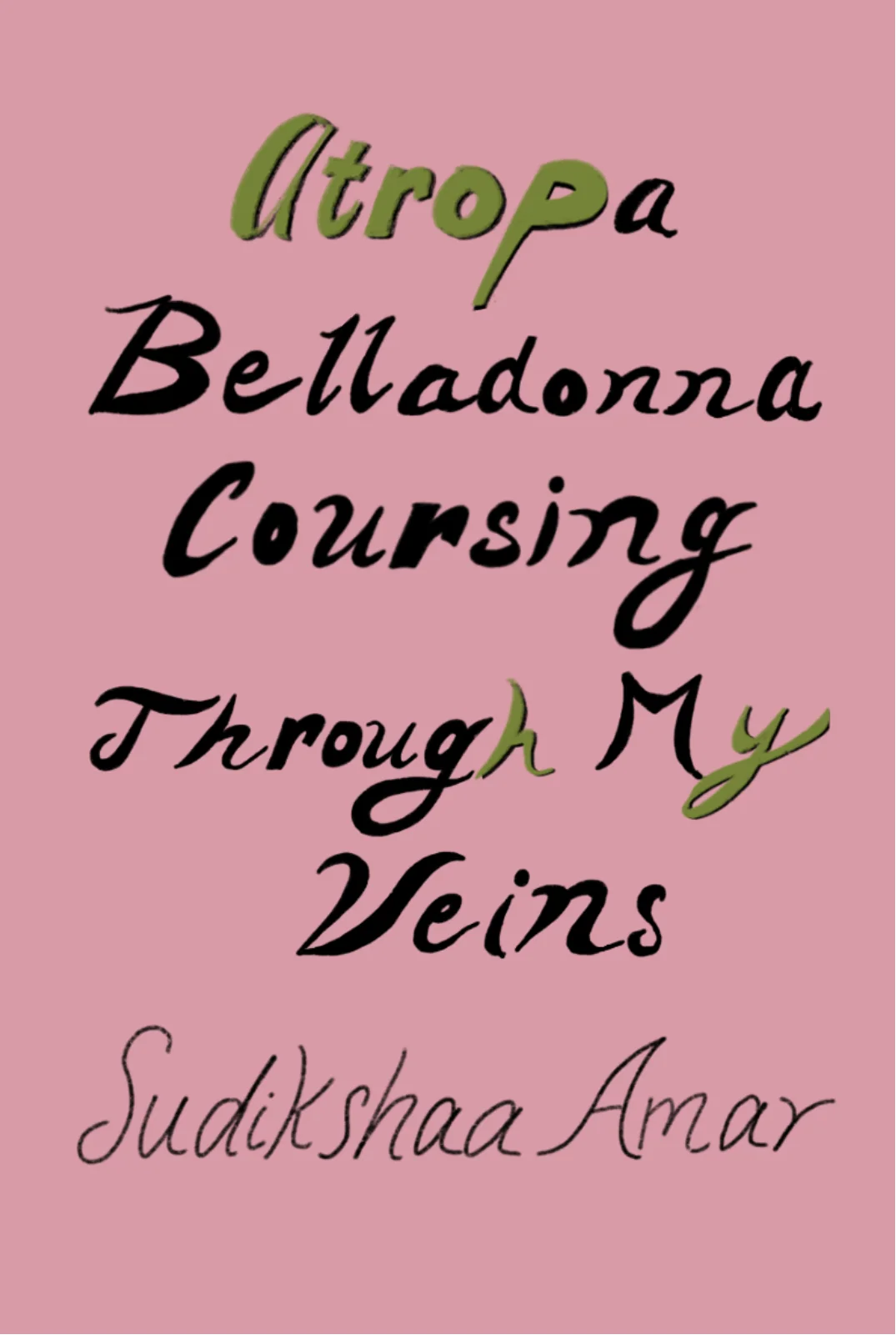
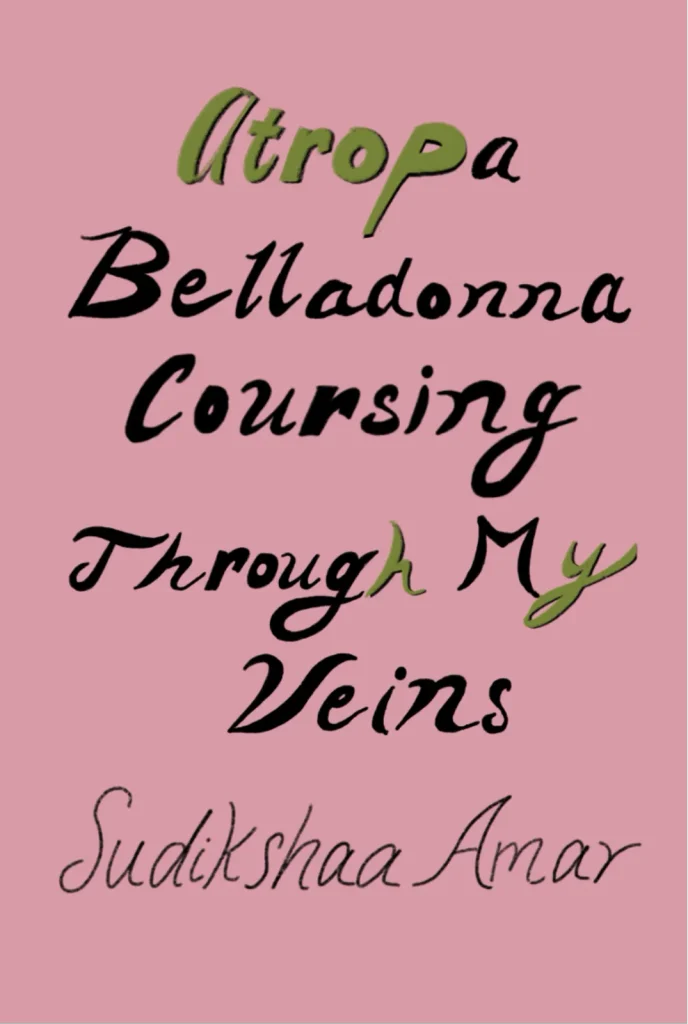
Atropa Belladonna Coursing Through My Veins
Sudikshaa Amar
Dancing Girl Press, 36pp., $10.00
In Atropa Belladonna Coursing Through My Veins, poet Sudikshaa Amar uses language to explore the limits of the disabled body. The speaker’s voice emerges from a distinct lexicon which blends autobiographical detail, technical medical vocabulary, and lyric images representing sensation. Amar’s varied descriptions of embodied experience—or as one poem is titled, “Some Synonyms of Paralysis”—let readers see into the work of forging a personal nomenclature for identity and action.
By mixing personal and technical vocabulary, many of the chapbook’s poems require readers to learn in order to inhabit the poet’s world. The work’s autobiographical nature is established in a series of first-person free verse narratives with titles set in time and place, including “In Utero,” “Neonate,” “Fremont, CA (2007),” and “Alcosta Blvd.” Atop this foundation stand more lyrical pieces such as “Damascus Steel,” which uses a storied metal’s unique forging process as a metaphor for “Direct face-off with palsy.” Over three pages, the speaker uses specific nouns to inform both literal description and figurative meaning:
Cerebrospinal ooze injected
in half-goat, half-ballerina.
Layers embedded like
the dance of carbon steel in spiral formation,
precision of a straight edge
held perpendicular
to dorsiflexion,
offset by shrinking talus
and dead achilles
far out into no man’s land.
Appreciating all the connections presented by the poem would require most readers to quickly reference “dorsiflexion” and “talus,” and perhaps the legends of “Achilles,” in a text that has already included “corp(u)s (callosum),” “metatarsals as prisoners of war,” and “the annexation of meniscus.” By using vocabulary that forces readers to engage with the disabled body on its own terms, Amar’s work replicates a learning process that many disabled subjects and their caregivers are similarly forced to undergo.
There are also a few exciting flights of exploration in atypically structured language. One standout is “Some Synonyms of Paralysis,” a list poem of thirteen numbered phrases which include anatomical terms (“Hallux Valgus,” “Juvenile Metatarsus Adductus,” “Drop foot”), personally affective symbolism (“Sickle and hammer,” “Lotus bed,” “Hephaestus”), and brief conceptual frames for experience (“Tether to sea level,” “Analog being”). “Synonyms” is followed by “Babinski Reflex” (titled after a test measuring toe response to foot sensation), a justified-alignment block of text using the inset slash punctuation to rapidly juxtapose lines:
raw pink flesh transition/into a calloused mass of nerve endings and arteries/crawling out from under to escape/like some hellish beetle gauging the weight/of impact, hissing under./sinusoidal anomaly,/appendages splay centrifugal/as if they were meant to disobey/the laws of the natural world/and dismantle the developmental hierarchies of piaget and erikson.
Vocabulary from mathematics and child development mixes with image and simile to convey a sense of disruption, whether the norm is a sinusoidal wave pattern or a typical adolescent stage. Amar also casts her net of language using traditional forms such as the ghazal; in “Geranium: A Ghazal” (which repeats the word “proxy”), as well as the acrostic, in “Salvia” (a poem whose initial letters spell MUTATE REALITY MERGE BODY). These experiments in structure are able complements, harvesting a cache of associated material—nouns, images, metaphors, and more—that other poems in the collection are able to draw upon.
As the chapbook progresses, Amar’s work conveys the collapse of a distinction between body and ailment. In “Arc and Channel,” a narrative of “spur and nerve damage” (11), the speaker invokes the image of a dead or captured host: “instead of vertebrae, my spine emerging from / mycelium-mummified exoskeleton.” Later, in “Fashioning the Lotus,” the speaker characterizes the body using a range of surreal images and abstract nouns:
Circulation of mesh and
web to speak into.
The mouth is no longer
vessel to contain tendril with
iron fist.
Spinal column fashioned out
of barbed wire.
Carve out of a steal,
bent and stretched,
stands either in total isolation
or within cluster.
Instead of exacting precision, readers experience the broadly resonant meaning of more general terms, uncommonly arranged. This works to a certain point, but as the chapbook extends its length, unchecked drift into mixed metaphor and unfocused narrative becomes a weakness. By the time readers arrive at the last poem, “Footsteps of Tilden,” which details when a “communal joint dwindles into a roach” amidst an “inebriated congregation swaying to / The Grateful Dead,” one gets the sense of a core narrative carrying excess weight that could have been excised.
Despite its weaker points, the chapbook’s climactic moments occur in the negotiation and exploration of nomenclature of the body. In “Attempt 47,” the self-described nineteen-year-old speaker opens by questioning media representations of disability in direct-to-consumer pharmaceutical marketing: “Why do people grifting about cures for knee pain always / refer to a promise to bond more with children and grandchildren? / To compress the patella and Achilles like a stolen birthright” (17). After a meditation on “The vessels that make up my being,” the poem closes by representing the disabled subject’s dynamic relationship to common forms of address:
Once the realization sets in…
The cleave strikes down after plantar ‘flexion’ locks into place.
Now the word cripple sounds more like an afterthought than a punch
to the abdomen.
Such direct characterization of how the common noun “cripple” can be experienced by the disabled subject complements the earlier treatment of common images in media. These shared symbols and many more are part of disabled life and Amar’s work gives readers some small exposure to their affective power.
Since only two of the poems have been previously published, there is currently no other way to appreciate this artifact of the University of California-Berkeley neuroscience student’s early work. If the poet continues to develop her voice with focused efforts at stylistic experimentation, then readers may look forward to both continued insight and increased coherence in a sophomore collection.
About the Author
Sudikshaa Amar is a poet raised in the San Francisco Bay Area and a student at UC Berkeley studying neuroscience and history. Her work has been published in LiveWire, Kinpaurak, Wordgathering, fifth wheel press and elsewhere, and she is a member of the Matwaala South Asian poetry collective. She currently serves as a poetry reader for Rawhead. When not writing, she likes to crochet and forage for mushrooms along live oak and coast redwoods.
Contributor Bio
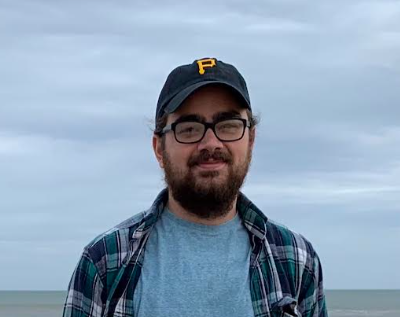
D.W. Baker is a poet, editor, and teacher from Saint Petersburg, Florida. His poetry appears in Identity Theory, ballast, and Sundog Lit, among others, and has been nominated for Best of the Net. He reads for several mastheads including Variant Lit and Libre. He serves as a Contributing Editor and Poetry Reader for Philly Chapbook Review.
Contents
October ’26: Best of the Net, New Staff & New Schedule
Managing Editor Aiden Hunt shares about Philly Chapbook Review’s staff changes, Best of the Net nominations, submission stats, and new publication format in this editor’s note to Issue 14.
“I always feel like I have so much to say to my mother and in this poem, I selected a few memories to share. In a way, this creative choice is symbolic of waving my white flag…” Read three poems by Natalie Zhang, along with a few words about “Flagship.”
The Vocabulary of Disability: On Atropa Belladonna Coursing Through My Veins by Sudikshaa Amar
“Amar’s varied descriptions of embodied experience…let readers see into the work of forging a personal nomenclature for identity and action.” Read the full chapbook review by Contributing Editor, D.W. Baker.