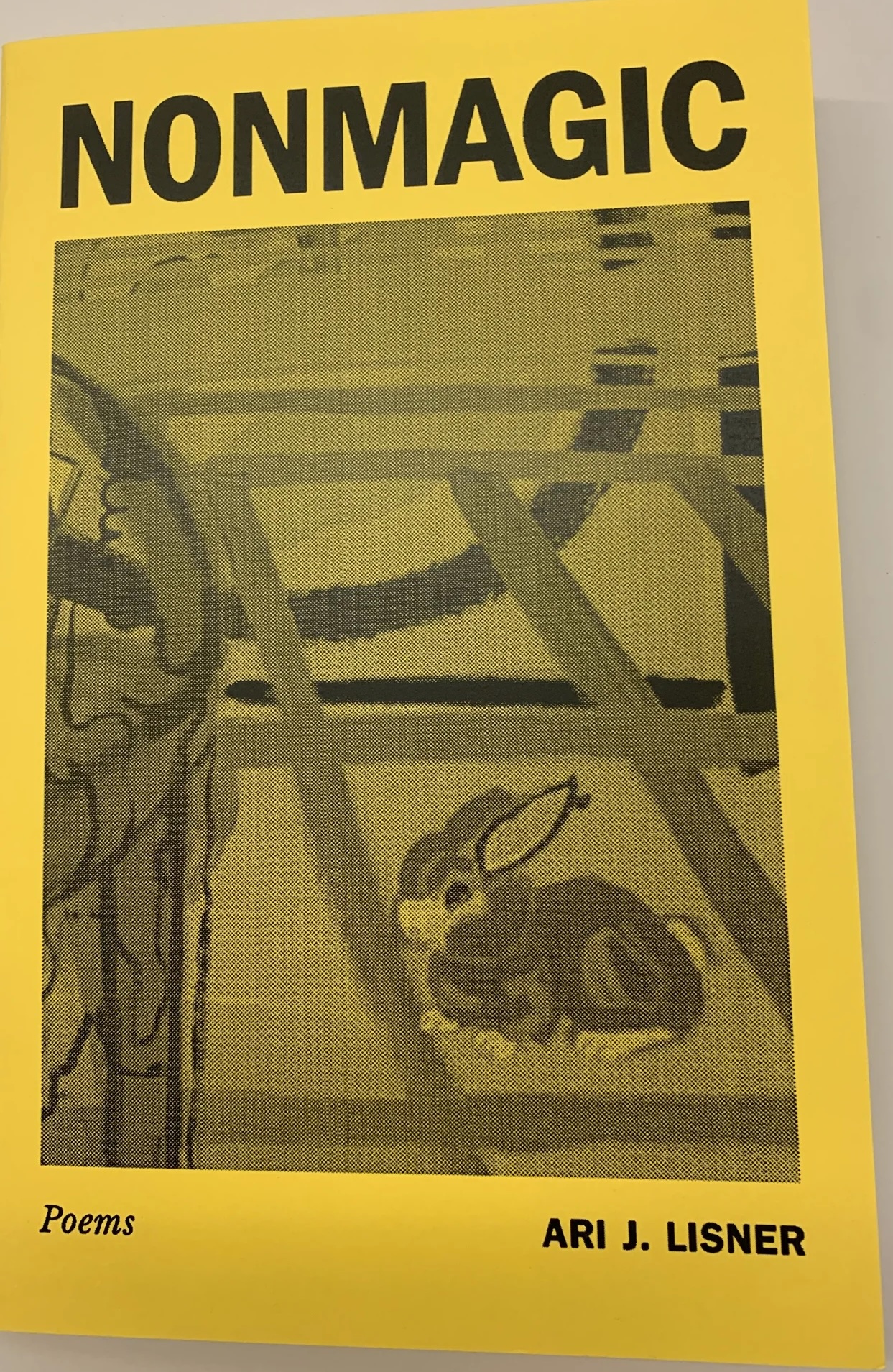
With a mix of biting humor and sincere tenderness, Ari J. Lisner’s Nonmagic walks through the stages of a failing relationship, while not so direct as to be telling. The reader is clued in on the story through hints and allusions scattered by our speaker. Nonmagic is a masterclass in voice and free association. Lisner’s speaker sings in a stream-of-consciousness, stirring notes of tension and uncertainty, and yet this collection is equally entertaining, endearing, and quite funny.
Love and joy, pain and disappointment – the charm of Nonmagic is that it has all these things, as does life and most relationships.
Editor’s Note: This interview was conducted via email over the summer of 2026.
What initially drew me to Nonmagic was your use of popular culture to engage the reader, making the poems feel casual and conversational. Can you talk a little about how popular culture influences your writing style and it’s value to contemporary poetry?
Popular culture in my poems appears as a way of achieving specificity, either for a spot-on simile, or else because things truly happened that way. I tend to use references to films, songs, products, and locations to the same end as I write about the birds; as stage-setting.
If I see a movie I love or eat something amazing somewhere, you’re going to hear about it from me. I live life like I am getting a referral bonus. That satisfaction is in part why I am currently producing [film]. I want people to see what matters to me.
In contemporary poetry, overreference can be a crutch. I edited out an inline Harry Potter reference in “Chamber Of Secrets.” The title was enough, there was no need to bonk readers over the head. I prefer a dogwhistle.
Was there a catalyst or a central piece that you built the collection around? Can you tell us about your creative process and how this book came together?
Nonmagic is in response to a relationship at a fundamental impasse, written in lieu of “bubble-bursting” the tension of the unspoken. It was written in an effort to live in a state of suspense for as long as I could muster. Many of its poems were assembled from notes in my phone, ideas and images that came to me in the thick of it.
In pieces like “Hours of Certainty” and “You Cherish the Unspoken” the speaker is ambivalent in their guarded tenderness. How do you navigate that space between sincerity and vulnerability?
Therapy has taught me not to be over-reliant on the Charlie Brown archetype for myself, so these poems were the byproduct of pushing back on that inclination.
Your voice reminded me of a Frank O’Hara-style colloquialism and sense of humor along with a certain distractible stream-of-consciousness. Can you tell us about your poetic and artistic influences?
This is a flattering comparison. O’Hara is an influence, so I am pleased to hear you can draw some similarity. During the Nonmagic time, I was listening to music that felt as if it came from the depths of the earth up to one’s ears, rather than from above in space, downward to be heard. “If I Stay Too Long” by The Creation, “Dolphins” by Tim Buckley, and “Gentle On My Mind” by Glen Campell are songs that embody that orientation to me. I was also watching films that have dreamy, romantic qualities: Bergman Island directed by Mia Hansen Love, Four Adventures of Reinette and Mirabelle directed by Eric Rohmer, and also films that face the tension of the unspoken, like A Woman Under The Influence directed by John Cassavetes.
These songs and films and poems felt connected to a new way of romance that I might reside in, so long as I had the willpower to believe without address. I want to stress that it was an entirely different way of existing for me. Whereas prior I wanted to name everything in order to legitimize it, agree upon it, have it reified, and enjoy life’s ironies by force. Especially moving for me was the scene in Reinette and Mirabelle about the “blue hour,” where the teenage girls seek the moment in early morning time where the sky is blue, but the birds have not begun to chirp. At first, this way of relation seems gentle and faith-based, but in reality, it had an unsavory side too, rooted in desire and connection. That’s what Nonmagic contends with.
There is a push-pull energy throughout the collection that you set up wonderfully through juxtapositions between honesty and acceptability, joy and pain, the spoken and unspoken. How did you work toward building up that internal tension?
That was the tension that I was living through. Plus, my poems often feel balanced by my psychological need for symmetry. They adhere to my internal logic.
Love, reciprocity, and disappointment are all central to this collection. How did you manage to emotionally distance yourself enough to be able to use those feelings as subject matter?
I spent a lot of time editing the manuscript, which bought me time and distance from the realities of the relationship I was writing directly about. I worked closely with the excellent Ugly Duckling Presse editor and poet Milo Wippermann. Milo encouraged certain considerations about form and narrative. The poems were written in late 2022 and through 2023, but not published as a collection by Blush until February 2026. I am impatient, but recognize now, of course, how useful healing was for the work, and presenting it undramatically.
In the title poem, the speaker swears to “taking on the project / of a simple sexuality.” Would you tell us more about what this means to you?
This line is about the immense, project-like effort it felt like to come off as effortless, to plausibly deny, and play it cool. I wonder if it was a postpandemic symptom, this obsessive-compulsive idea of aesthetically engineering swagger to conjure the romance I wanted. I have studied men all my life because I had always wanted to be one. I fixate on products as solutions. So it was the heather gray Nike hoodie that felt like it could fix everything. The project of a simple sexuality is like when guys were obsessed with getting a sexy basic silver chain like Paul Mescal had in the TV show adaptation of Sally Rooney’s Normal People. The pursuit is sort of disgusting.
In “Return to Sender,” your speaker calls themselves a “salesman of love.” Is there anything more you’d like to say to a reader who might also consider themselves to be the same?
Believe in your product.
Do you have any upcoming projects or events, like readings or forthcoming publications, that you’d like our readers to know about?
I am an Associate Producer on a queer independent feature film Nothing To Hide that is in its final fundraising stages! You can make a tax-deductible donation here if you’d like to support it. Plus, be on the lookout for the webseries I am a Producer on called Bella Is Famous, written and directed by comedian Nico Carney. Lastly, a relatively newer poem of mine called “Simple Man” will appear in Alchemize: a trans poetry anthology in Fall 2026, which you can order here.
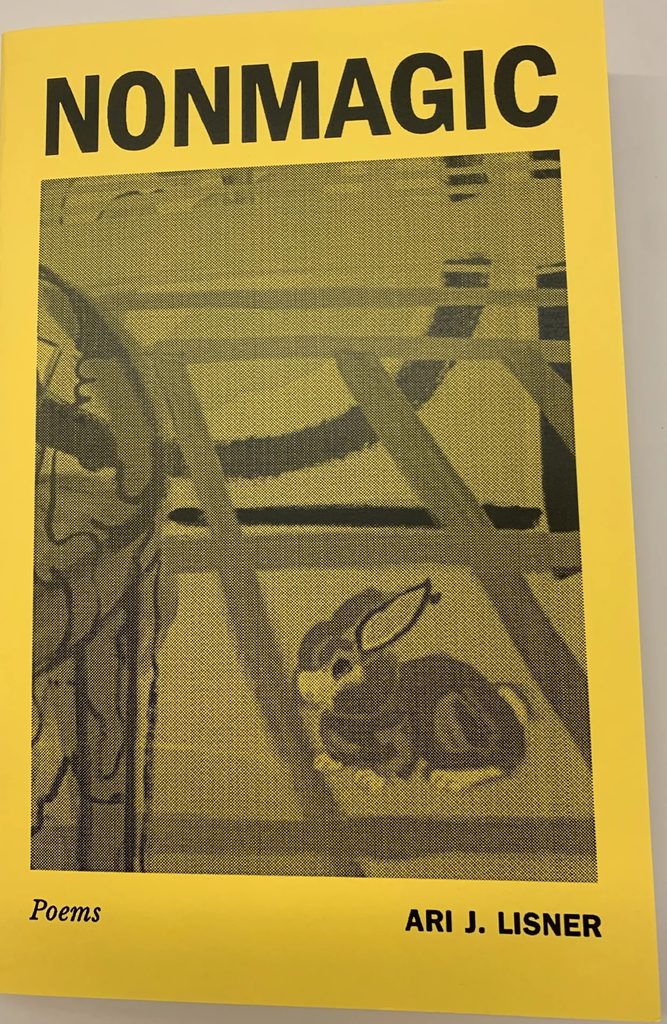
Nonmagic was published by Illicit Zines in the early 2026. It can be purchased via Blush here. Copies are printed on vintage paper in an assortment of vibrant colors that the author aligned to different filmmakers’ vibes.
Ari J. Lisner is a writer, researcher, and film producer in New York City.
About the Contributor
Danielle McMahon is Interviews Editor and a Poetry Reader for Philly Chapbook Review, as well as the author of four poetry chapbooks and two micro-chaps. Most recently, her micro-chap rowhouse song was part of the 2025 Ghost City Press Summer Series. Her latest chapbook irl is now available from Stanchion Books. She is the Editor of the engine(idling.
Contents
October ’26: Best of the Net, New Staff & New Schedule
Managing Editor Aiden Hunt shares about Philly Chapbook Review’s staff changes, Best of the Net nominations, submission stats, and new publication format in this editor’s note to Issue 14.
“I always feel like I have so much to say to my mother and in this poem, I selected a few memories to share. In a way, this creative choice is symbolic of waving my white flag…” Read three poems by Natalie Zhang, along with a few words about “Flagship.”
The Vocabulary of Disability: On Atropa Belladonna Coursing Through My Veins by Sudikshaa Amar
“Amar’s varied descriptions of embodied experience…let readers see into the work of forging a personal nomenclature for identity and action.” Read the full chapbook review by Contributing Editor, D.W. Baker.
A Conversation with Ari J. Lisner
“Nonmagic is in response to a relationship at a fundamental impasse, written in lieu of ‘bubble-bursting’ the tension of the unspoken. It was written in an effort to live in a state of suspense for as long as I could muster.” Poet Ari J. Lisner discusses their chapbook, Nonmagic, their creative process, and the influence of Frank O’Hara in this interview with editor Danielle McMahon.