
Philly Poetry Chapbook Review is pleased to present five original poems by William Doreski as our second of seven biweekly featured poets of the Summer 2025 issue.
Poems
The Poems of Hart Crane
The axis on which I turn
extends deep into the earth.
As I slowly revolve on it
texts printed in green and red ink
flash by before I can read them.
They might answer bulky questions
about the source, purpose, extent
of the universe. They might flatter
my lack of self-esteem and rouse me
to the secret pleasures of ageing.
They might prove the existence
of people, flowers, and bedrock.
They might map greater cities
than Shanghai, Athens, and Milan.
Although I’m affixed on this axis
like a moth on a pin I’m able
to exert peripheral vision
and glimpse marshland fuming
and streets of dusty brown storefronts
no customers seem to visit.
The axis has replaced my spine
so I can’t rouse old politics
and return to youth when slogans
felled a government and the poems
of Hart Crane severed me
from the childhood I didn’t cherish
early enough to survive it.
What’s Written Above is Read Below the Horizon
The long and cloudy transcripts
passing overhead instruct us
in dialogues of lake and hill.
How can we learn to affix
this wonder in marble or brass
like the rest of our imaginings?
Consider Lord Elgin obsessed
with sculptures he hadn’t seen.
Think of Eliot the churchman
hooked on heavenly dimensions
his limp gray clothing concealed.
You read the sky-hung manuscript
without suspicion, as if birds
were the only intelligence left.
But songbirds are going extinct,
so where does your theory land?
I trust nothing dressed in vapor,
the distance folded and sealed
like an envelope full of cash.
But lacking sturdy work shoes
I’m likely to topple headlong
into the shallows and risk
the authentic hypothermia
that lingers for several lifetimes,
a shiver that passes for speech.
Something of Perspective
The radial aspect of our town
rotates on an east-west axis
that’s cultural, not geographical.
We examine local artworks
to determine their orientation,
which isn’t always apparent
in their subject matter or palettes.
The town grumbles subtly
as its angles of vision shift.
The art becomes unstable.
Sculptures crack, paintings peel,
and conceptual installations lose
their concepts and their audience.
We chose to live here because
the avant-garde seemed alive
with adventure. Now the bulk
of our folly looms before us
for a moment before reshaping
into brilliance instead of madness.
How can we settle in such
a prolonged intellectual chaos?
Our friends agree that the village
leans both left and right, houses
groaning on their foundations,
churches tipping their steeples.
We gather in public places and read
the grimmest philosophers aloud.
The police would like to stop us,
but they lack the probable cause
more stable artwork would give them,
the radial movements criminal
in outcome although not intent.
Trying to Rhyme Myself
The city retains a residuum
of the lives we tucked away,
hoping they’d ripen in the dark.
The Back Bay streets flicker
like ribbons tossing in wind.
The Esplanade retains footprints
from our long walks decades ago.
In a bakery with a plate glass smile
I slurp a mocha latte and watch
several versions of your ghost pass
with serious but vague expressions.
Your death wasn’t exaggerated,
although you linger in the flesh.
After noshing a plain croissant
I exit into muddles of cloud
that promise everything but rain.
Yes, I’m trying to rhyme myself
with you but making hash of it.
The city outweighs us mightily
but can’t persist without us.
The skyscrapers will soon wilt,
the subway system will tangle
like a plate of runaway spaghetti,
the storefronts will bleed real blood
in memory of the books we read
all night, refusing to face ourselves.
Physics Newton Overlooked
The four corners of this room
invite me to sit in all of them
at once. I do, and I feel more
angular than ever before.
The north corner smells of mice.
The south corner’s too dark
to reveal its possible secrets.
The east corner expects me
to share the space with a god.
The west corner trembles with rain
festering from one tiny cloud.
I could gather my divided
attention and leave the room
but I sense a dynamic forming,
a physics Newton overlooked.
The room has no windows but
I see outside in all directions.
Someone’s driving past with
a clatter of damaged gears.
Someone’s sitting in a ditch
cuddling disembodied smiles.
A priest is mumbling to himself.
A dog wags but looks uncertain.
Direction and misdirection mate
and create a whole new person
and invite me to occupy
an otherwise vacant shell.
About “The Poems of Hart Crane”
My poetry tries to examine the gap between self and environment. That is, the difference between the lives we live inside ourselves and the lives we expose to other people.
Author Bio
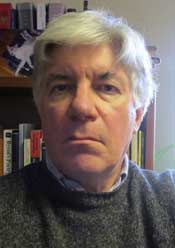
William Doreski lives in Peterborough, New Hampshire. He has taught at several colleges and universities. 2024). He has published three critical studies, including Robert Lowell’s Shifting Colors. His essays, poetry, fiction, and reviews have appeared in various journals.

Contents
Chapbook Poem: The Blessed Knot by Li-Young Lee
“A well-made poem is a knot, but not a tangle. The well-made knot of a poem can disentangle readers from illusion, to free them from confusion. Poetry is a form of disillusionment.” Read the July Chapbook Poem by Li-Young Lee along with words from the poet.
“This work is an archive of my attempts to become more familiar with who I am, and why I am here, to immerse myself in these ancient spiritual questions…” Check out five poems and five images by Laynie Browne along with a few words from the poet.
Book Excerpt: Creating Space by Lisa Sewell
“Yoga, the walks, and the writing became a daily exercise in paying attention—to the world, to the bodies in the world around me and to my own body…” Read the Excerpt Poem of the Month for July 2025 by Lisa Sewell along with words from the poet.
“My poetry tries to examine … the difference between the lives we live inside ourselves and the lives we expose to other people.” Read five poems by William Doreski along with a few words from the poet.
July ’25: Poetry Readers Wanted
Read a note from editor Aiden Hunt about PCR’s Summer poetry and new poetry reader opportunities brought by our growing original poetry submissions.
Four Poems by allison whittenberg
“I grew up as a film buff and I loved reading Hollywood Babylon. Over the years, I have learned to separate the truth from the myths.” Read four poems by allison whittenberg along with a few words from the poet.
Chapbook Poem: August Peaches by Winshen Liu
“I wanted to sit with a particular end-of-summer indulgence, where a host has saved specialty foods to welcome visiting friends and family–fancy chocolate, favorite sodas, a certain snack.” Read a poem from Winshen Liu’s chapbook Paper Money along with words from the poet.
Book Excerpt: Cheesecake Factory by Max McDonough
“This poem lives in the weirdness of the suburban mall spaces a lot of us grew up visiting (or loitering in!), places that feel like they could be anywhere and nowhere at once.” Read a poem from Max McDonough’s chapbook along with words from the poet.
Three Poems by Alexandra Meyer
“Love had made me stronger in a lot of ways, but also showed me the weakest parts of myself that were left crystallized for him to see. This was much like wood morphing into rock during the petrification process.” Read three poems by Alexandra Meyer along with words from the poet.
Three Poems by Kristiane Weeks-Rogers
“Anchored by sensory detail, the poem journeys between childhood safety and adult experience in a canyon town shaped by rivers and monsoons. … This poem is a meditation on time, tastes, and tenderness of memory.” Read three poems by Kristiane Weeks-Rogers along with words from the poet.
Chapbook Poem: The Seventh Age of Shakespeare’s Father by Scott LaMascus
“This poem hit me hard last winter, sitting a moment near my late father, as our family was trying to absorb the meaning of his ALS diagnosis … I wondered, if ‘all the world’s a stage,’ what role had I just been assigned?” Read the featured Chapbook Poem of the Month for September 2025 along with words from the poet.
Book Excerpt: Landscape with footprints in ash by Selma Asotić
“When I want to sound smart, I say things like: a poet is one who leaves. When I accept that I’m not very smart, mostly just perplexed and a little scared, I write poems about ghosts and circle farms.” Read a poem from Asotić’s new book, Say Fire, along with words from the poet.
“All of my encounters with the U.S. healthcare system follow the protocols of the ridiculous. This poem, couched in the conventions of the contemporary sonnet, explores my latest, decisive encounter with a doctor’s office.” Read three poems by Robin Arble along with words from the poet.
September ’25: Best of the Net Nominations
Editor Aiden Hunt announces Philly Chapbook Review’s Best of the Net 2026 anthology nominations in this editor’s note and provides links to the nominated poems.
Verses of Mourning: in the aftermath by Jessica Nirvana Ram
“[Ram] presents a revealing and heartbreaking collection that asks the reader to think about what they remember the most about those they have lost.” Read Alex Carrigan’s full review.
“This poem reckons with our capitalist, product-driven society to ask people why disabled stories are only relevant if they portray the ‘other’ overcoming trauma to become abled people’s inspiration porn.” Read three poems by Makena Metz along with words from the poet.