
We here at Philly Chapbook Review love poetry, whether it’s in chapbooks or full-length collections. We have a hunch that our readers do, too. Every Tuesday, we publish an update about what full-length poetry titles we know are releasing in the following week.
Information, including product descriptions, is provided by the publisher and not a critical judgment. If we cover the book on this site, links will be included.
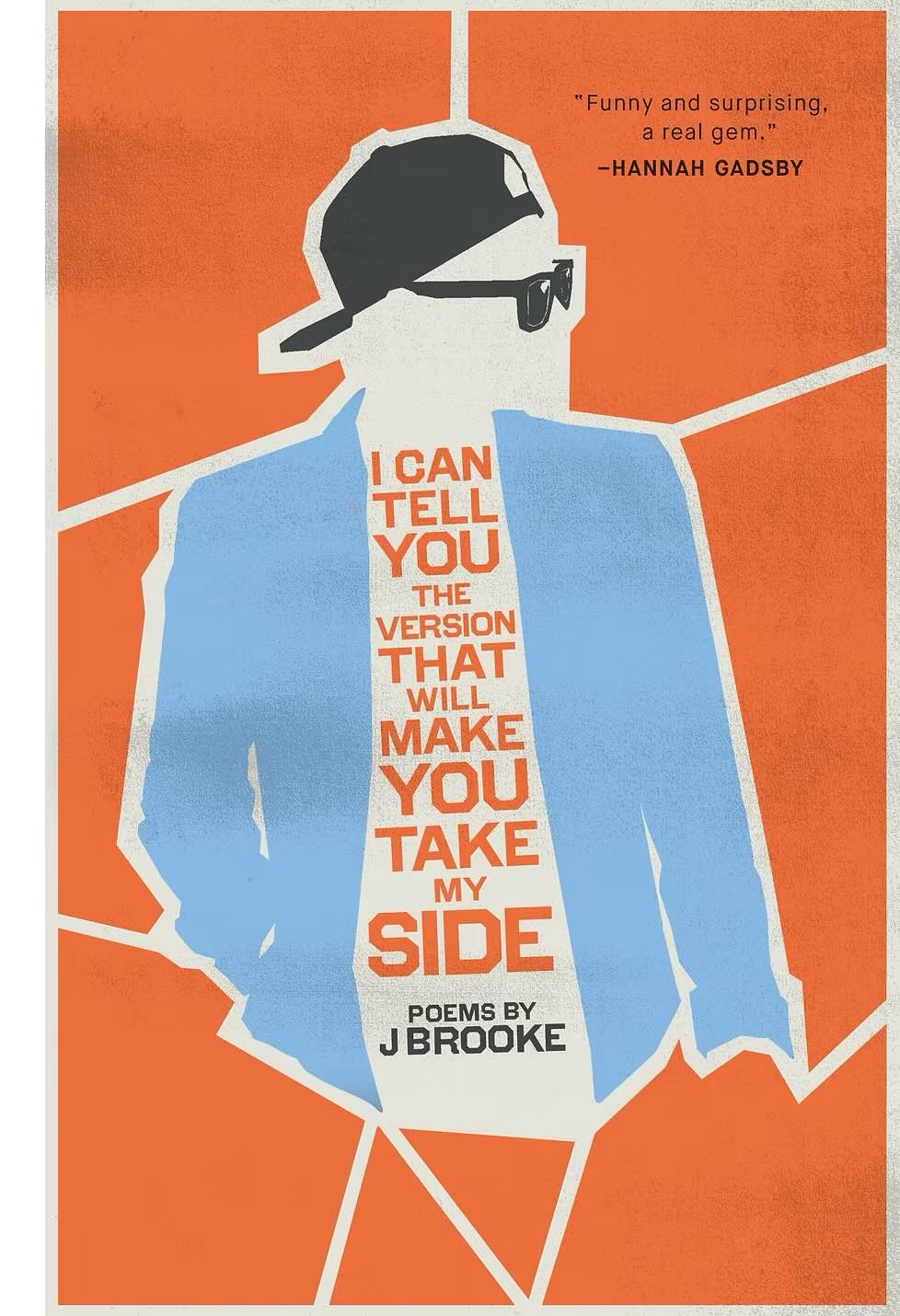
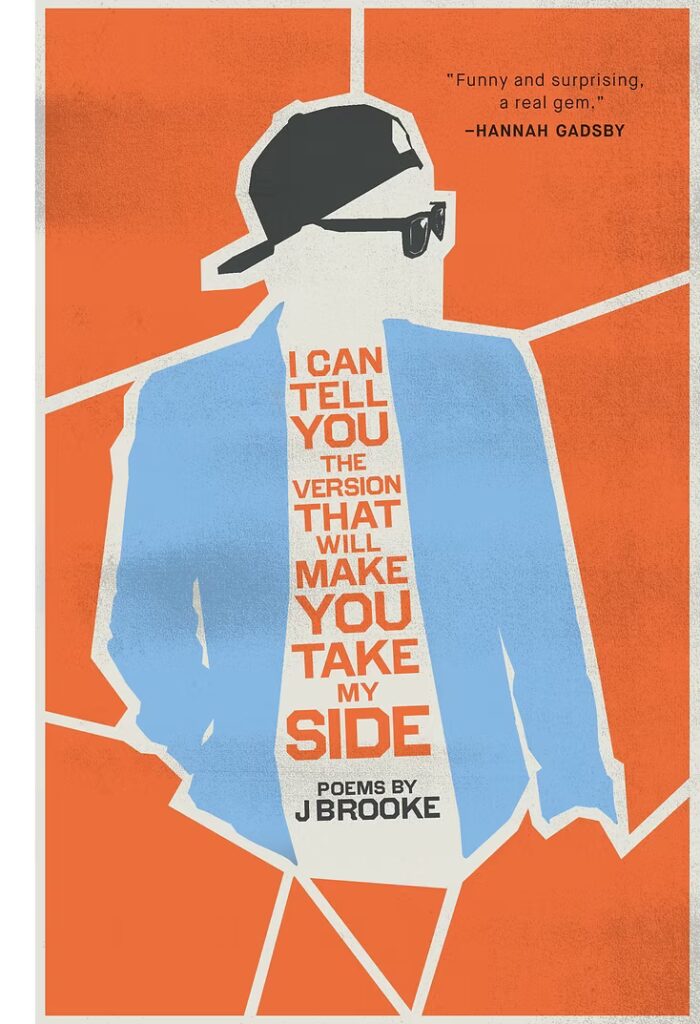
I Can Tell You the Version That Will Make You Take My Side, J Brooke
Publisher: Driftwood Press
Publication Date: June 2, 2026
Format: Paperback
J Brooke’s I Can Tell You the Version That Will Make You Take My Side begins in a childhood full of binaries, then navigates through an American queer / trans / nonbinary adulthood fraught with complexities including the question of top-surgery.
J Brooke’s work is known for exploring gender, family, and the incendiary combination of the two. With this, their first book, they deliver candid commentary on a unique gender journey. Born intrinsically male, assigned female at birth, and raised in affluent dysfunction in New York City, their gender expression attempted male, cis straight female, and cis gay female before embracing a nonbinary identity. Living without surgical or hormonal interventions, their struggle to find authentic place traverses female anatomy, friendship, suicide, family, testosterone, politics, packers, social media, motherhood, royalty, natural phenomena, cancer, marriage, and the pope. Brooke is Prose Reviews Editor at The Rumpus, and lives in New England with their beautiful spouse Beatrice.
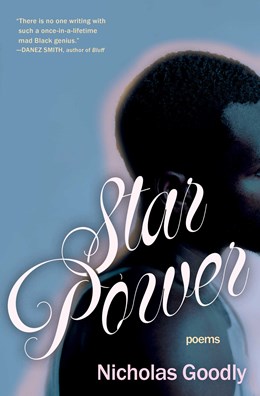
Star Power, Nicholas Goodly
Publisher: Scribner
Publication Date: June 2, 2026
Format: Paperback / eBook
In this collection, a jubilant testimony to the joys and hardships of the Black queer experience, poet Nicholas Goodly explores language that venerates the saints of their life—those people in cultures and communities who are not often seen as the powerful, brave, and heroic figures that they are. An ode to endurance, love, and play, Star Power carves out a place of pleasure and solace, a personal pantheon of legends from the Wonder Twins, Thundercat, and Tiffany Pollard to Venus Xtravaganza, the Olsen Twins, and Grace Jones.
Defiant and unapologetic, Star Power charts a path of joy and wonder, cutting through caustic history and an oppressive present to speak directly to these vibrant lives, which have long been overlooked.
Nicholas Goodly is the author of Black Swim. Goodly is the recipient of the 2017 Chapbook Fellowship from the Poetry Society of America and was a finalist for the 2020 Jake Adam York Prize and the runner-up for the 2019 Cave Canem Poetry Prize.
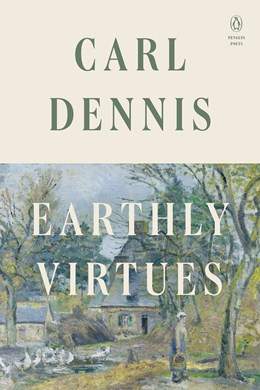
Earthly Virtues, Carl Dennis
Publisher: Penguin Books
Publication Date: June 2, 2026
Format: Paperback / eBook
Though most of the virtues that interest Carl Dennis in Earthly Virtues have traditional names, they are provided with contexts that give them fresh implications, moving us in two directions at once, toward a recognition of limits and a recognition of possibilities. On one hand, they confront what it means to lack the knowledge and power we need to make our lives as consequential as we may want them to be. On the other, they reach out to widen the circle of our concern, suggesting a kinship of the local with the distant, enlarging the passing moment with history and prophecy. Wherever the poems turn, they prove spacious enough to take us with them, and they leave us grateful for the journey.
Carl Dennis is the author of fourteen books of poetry, most recently Earthborn (2022). A winner of the Pulitzer Prize and the Ruth Lilly Prize, he taught for many years in the English Department of the State University of New York, and in the Warren Wilson Writing Program in North Carolina. He lives in Buffalo, New York.
Let the Forest Go, Justin Wymer

Publisher: The University Press of Kentucky
Publication Date: June 2, 2026
Format: Hardcover / Paperback
Let the Forest Go is a memoir in poetic fragments that follows a queer Appalachian’s quest for truth as he explores memory, intergenerational trauma, and the rise of authoritarian power. During the turbulent 2016 US presidential election, Justin Wymer experienced a sense of dislocation while teaching English in Spain—where the landscape resembles his home region, but cultures differ deeply. Through letters, poems, and vignettes, this intensely personal and formally inventive work captures his impressions, blending lyric prose and verse to offer a unique examination of belonging.
In this liminal space, time, and environment, Wymer dissects his multifaceted identity as an expat, a gay man raised in a religious, small West Virginia town, a member of a family involved in the opioid epidemic, a mourner caught within Appalachia’s poorly understood grieving rites, and a human witness to ecological devastation. By searching for beauty amid past and present destruction, Let the Forest Go attempts to embody queerness through fluctuating form and interrogates whether memory, being unavoidably fictional, is a viable source of inspiration.
Justin Wymer is a writer and educator from West Virginia. He is the author of DEED and has been honored by the Harvard Office for the Arts, the Radcliffe Institute, the University of Iowa, and the Academy of American Poets. His work appears in the Boston Review, the Kenyon Review, Literary Hub, and other publications.
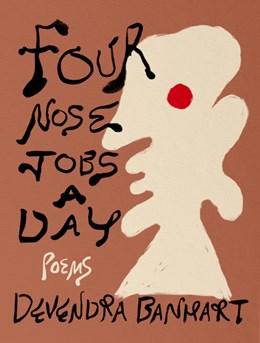
Four Nose Jobs a Day, Devendra Banhart
Publisher: The Unnamed Press
Publication Date: June 2, 2026
Format: Hardcover
With Four Nose Jobs A Day, Banhart’s second collection, the poet explores matters of the heart and soul through an absurdist lens both sly and compassionate. As the opening lines of the collection alert us, Banhart loves “a Love Poem/One that reads/Like Blackberries/On a wooden cup”. With iconoclastic verve, Banhart builds small, often silly paths of poetic language that lead to meaningful conclusions: “Poetry is when/the dead end/Starts to go somewhere”
Like professional musicians constantly on tour, Banhart reminds us that we, the readers, have countless places to visit both in the world around us, and inside ourselves—whether these places resonate and register is up to us, not the places. The poems of Four Nose Jobs A Day break the surface of reality, small bubbles of insight. Sometimes there is laughter in the face of absurdity; consolation for grief or despair; and sometimes there is simply gratitude. “What an Honor,” the poet reminds us, “To have emotions/Any of them.”
Devendra Banhart (b. 1980, Houston, Texas) lives and works in Los Angeles. He was born Devendra Obi Banhart in Houston, Texas, but spent his childhood in Caracas, Venezuela; as a teenager, his family returned to the States, relocating in Southern California. An internationally renowned musician, songwriter, and visual artist considered a pioneer of the “freak folk” and “New Weird America” movements, Banhart has toured, performed, and collaborated with Vashti Bunyan, Yoko Ono, Os Mutantes, the Swans, ANOHNI, Caetano Veloso, and Beck, amongst many others. His musical work has always existed symbiotically alongside his pursuits in the other fine arts. He has released 12 full length albums, been nominated for a Grammy, has released one book of poetry with Featherproof Press. His visual art has been presented across some of the most respected museums and galleries around the world. Exhibitions include Offering Cloud of Scattered Genitalia, Serralves Museum, Porto, PT; The Grief I Have Caused You, Nicodim Gallery, Los Angeles, Ca (2022); Other Flowers, Hauser and Wirth, Los Angeles, Ca (2019); Voglio proprio vedere, Mazzoli, Modena, Italy (2017); Sphinx Interiors & Other Works, Mazzoli, Modena, Italy (2014, solo); Abstract Rhythms: Paul Klee and Devendra Banhart, SFMoMA, San Francisco (2007–2008); Music is a Better Noise, MoMA PS1, Queens, New York (2007); and Devendra Banhart, Mazzoli, Modena, Italy (2006, solo). His monograph of drawings and paintings I Left My Noodle on Ramen Street (2015, Prestel) features essays by Jeffrey Deitch and Beck.
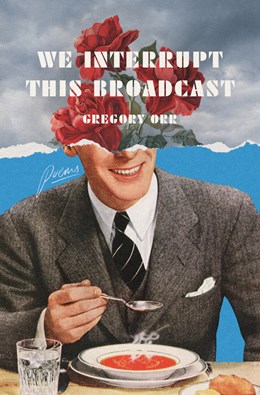
We Interrupt This Broadcast, Gregory Orr
Publisher: W. W. Norton
Publication Date: June 2, 2026
Format: Hardcover
From a master lyric poet characterized by Mary Oliver as “a Walt Whitman without an inch of Whitman’s bunting and oratory” comes this late-life collection that takes its overall title from the venerable phrase that alerted listeners and viewers to an urgent event of public significance. Again and again, the poems in We Interrupt This Broadcast dramatize, in simple and deep language, what it feels like to be alive in our time.
The disconnects that haunt and animate these poems are political, ecological, and psychological. Some, like “Un-Earth: A Sequence,” revisit early trauma experienced both intimately and socially, while others contemplate our present ecological crises.
Set against this somber background of disconnects, Gregory Orr invokes the natural world and human intimacy as sources of growth and hope. Giving voice to both personal and universal anguish, We Interrupt This Broadcast repeatedly transforms desolation into celebration, silence and suffering into song.
Gregory Orr is the author of fourteen collections of poetry and several books of prose, including The Blessings: A Memoir, A Primer for Poets and Readers of Poetry, and Poetry as Survival. He is professor emeritus at the University of Virginia, where he founded its MFA Program in Writing. He lives with his wife, the painter Trisha Orr, in Charlottesville, Virginia.
Don’t Let It Kill You, Theo LeGros

Publisher: Persea
Publication Date: June 2, 2026
Format: Paperback
From hospital rooms to dive bars, Don’t Let It Kill You by Theo LeGro confronts the complexities of loss and mortality with ferocity and wit. These poems test the tension between survival and surrender, healing and destruction, where the body is a site of betrayal and forgiveness, pain and longing, where the frailties of the flesh lead to a haunting tenderness toward the self. With language that refuses to flinch or flatter, these poems tells the truth about sickness: How boring it is. How brutal. How sacred. The poems do not seek to inspire. They do not resolve. They testify. Aching and defiant, Don’t Let It Kill You refuses to yield or comply, weaving between intergenerational trauma and incurable illness with biting lyricism to explore where desire and fear collide as proof of life and life is its own feral, sacred kind of rebellion.
Theo LeGro is a queer Vietnamese-American poet and Kundiman fellow whose work has earned nominations for the Pushcart Prize, Best of the Net, and Best New Poets. Their work appears or will appear in Blood Orange Review, Brooklyn Poets, diode, Honey Literary, Plume, The Offing, Raleigh Review, and others. They live in Brooklyn.
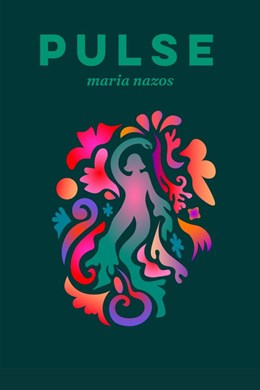
PULSE, Maria Nazos
Publisher: Omnidawn
Publication Date: June 5, 2026
Format: Paperback
The poems of PULSE look deeply into a troubled world, inspecting what makes us suffer and demonstrating how we overcome difficulties. PULSE interrogates painful losses of friends to cancer, harmful politics, hate crimes, and mass shootings, including the 2016 massacre at Pulse nightclub. Maria Nazos examines the life force that continues to pulse relentlessly through a fragmented world, that enables us to flow, breathe, and regenerate, even through grief and loss. From Provincetown beaches and Costa Rican crab shacks to Midwestern plains and a Tampa nightclub, the collection moves through madness, redemption, and love.
Maria Nazos is the author of A Hymn that Meanders and Still Life. Her poetry and translations have been published in the New Yorker, TriQuarterly, World Literature Today, Columbia Review, American Life in Poetry, and anthologies including What Saves Us: Poems of Empathy and Outrage in the Age of Trump.
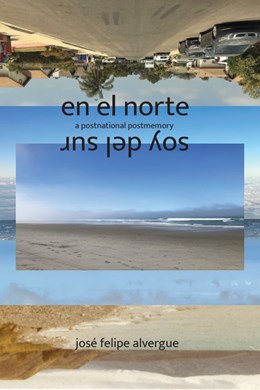
en el norte / soy del sur, José Felipe Alvergue
Publisher: Omnidawn
Publication Date: June 5, 2026
Format: Paperback
José Felipe Alvergue’s en el norte/soy del sur, which translates to “in the north I am of the south,” is an exploration into the limits of the American sonnet, one that seeks to establish a stable sense of place, while opening vistas at each turn. Stitching together multiple sonnets into what he calls “sonnet essays,” Alvergue rides their turns—or “voltas”—that are guided by memories and photographs of his family’s migratory history between El Salvador and the United States.
The resulting text is a story of human geography that considers the coordinates of a long, continuous thought about what it means to be “of a place” as a defining characteristic of identity, when one is also “in a place” that sets strict limits on the political and historical potential of im/migrants. A deeply human documentary work that delves into one family’s migration across the hemisphere, en el norte/soy del sur hopes to give shape to the collective and often amorphous history of migration in the face of narratives that peddle spectacularized distillation and essentialism.
José Felipe Alvergue is the author of four books, including his work of autotheory purplish: poetry anger publics and the poetry collections scenery and precis, the latter of which was also published by Omnidawn.
Las Palmas, Keith Jones

Publisher: Omnidawn
Publication Date: June 5, 2026
Format: Paperback
The poems of Las Palmas conjure, walk beside, and tarry with the entangled grief of the long histories and violences in which we are all still embedded. Jones offers homage to the anguished beauties and truths that poet Jay Wright once said were “the disturbances” that “our ancestors create in us.” Grounded in musicality and haptics, Las Palmas seeks to salvage and mend while meditating on materiality, loss, cartography, kinship, displacement, coloniality, the “modern” world, and climate disasters. Throughout this collection, Keith Jones finds truth and community amid despair and the cruelest of circumstances, working through traumatic intimacies and mapping new imaginaries.
Keith Jones (he/him) is the author of Echo’s Errand and the chapbooks blue lake of tensile fire; shorn ellipses; the lucid upward ladder; Fugue Meadow; and Surface to Air, Residuals of Basquiat. His poems have appeared or are forthcoming in Barrow Street, Chicago Review, Denver Quarterly, Flag + Void, Harvard Review, SX Salon, Transition, Verse, and elsewhere. He teaches in the Africana Studies Department at the University of Massachusetts Boston and is the current poet-in-residence at the New England Conservatory.
Don’t see a poetry title published between 6/2 and 6/8 here? Contact us to let us know!
Contents
Chapbook Poem: Slow Burn by Evan Wang
“The concept of personifying a slow burn deeply resonated with who I thought myself to be—a slow burn, love flickering around me.” Read the featured Chapbook Poem of the Month for April 2026, “Slow Burn” by Evan Wang, along with a few words from the poet.
Book Excerpt: She wants shimmering scales by Nicole Alston Zdeb
“The nexus of the erotic, the social, and the body felt relevant to what I was experiencing at the end of the 20th Century. There are glimmers of personal lore as well…” Read the featured Excerpt Poem of the Month for April 2026, “She wants shimmering scales” from The End of Welcome by Nicole Alston Zdeb, along with a few words from the poet.
“I wanted to explore how time was registered not only by the calendar and clock, but also in the various utilitarian tasks of my mother’s life.” Read three poems by Ron Mohring, our first biweekly poet of the Spring 2026 issue, along with a few words about “Fuse.”
Three Poems by Andrew Pelham-Burn
“Children in these circumstances are deprived of love at a formative stage and learn to immediately behave like adults without the benefit of the learning path of childhood.” Read three poems by Andrew Pelham-Burn, our second biweekly poet of the Spring 2026 issue, along with a few words about “Conkers.”
A Conversation with John deSouza
“Language is a powerful tool and can do great harm both to ourselves and to those most close to us when used cruelly or selfishly.” Poet John deSouza discusses his chapbook, This Rough Magic, his creative process, and the influence of John Ashbery in this interview with editor Danielle McMahon.
Chapbook Poem: from Stray Hunter’s Bullet by Lance Le Grys
“…what interested me was the idea of a character who didn’t do what he was capable of, not because of external circumstances, but because of either a lack of will or a seemingly perverse one.” Read the featured Chapbook Poem of the Month for May 2026, from Stray Hunter’s Bullet by Lance Le Grys, along with a few words from the poet.
Book Excerpt: Love does not exist by Maria Giesbrecht
“This poem was inspired by a dream… I had this strange feeling when I woke up that it meant something more and started writing a poem to see if anything would reveal itself to me.” Read the featured Excerpt Poem of the Month for May 2026, “Love does not exist” from A Little Feral by Maria Giesbrecht, along with a few words from the poet.
“After a loss in my family, I discovered one grieves for both the living who hide their pain and for the dead who sleep in silence.” Read two poems by Patricia Wallace, our third biweekly poet of the Spring 2026 issue, along with a few words about “Fox.”
May ’26: New Staff, New Calls, New(ish) Name
Editor Aiden Hunt provides information about changes to PCR’s name, format, and staff in this editor’s note, which also contains links to our Spring calls for submissions.
“I kept thinking about how easily adults learn to stop seeing what’s right in front of them, especially when they’re somewhere between one country and another, neither arriving nor leaving.” Read four poems by Nivara Lune, our fourth biweekly poet of the Spring 2026 issue, along with a few words about “Notes Toward an Elsewhere.”
The Lines of Landscape: on The Catastrophes by Marie Scarles
“Scarles’ choice of title points away from place, and toward the book’s deeper and more powerful offering: a changed way of seeing, one of the hallmarks of any successful poetics.” Read the full chapbook review by contributing editor, D.W. Baker.
“Every time I plucked a few of the little orange sun sugars to take inside, their garden smell lingered on my fingers. It was almost enough to just sit with that scent…” Read three poems by Kait Quinn, our fifth biweekly poet of the Spring 2026 issue, along with a few words about “The Tomato.”
Chapbook Poem: Superbloom by Joyce Schmid
“That June, flowers bloomed everywhere in Northern California—as if to honor her, to celebrate her life. This poem is an attempt to accept the fact that she is really gone.” Read the featured Chapbook Poem of the Month for June 2026, from Superbloom by Joyce Schmid, along with a few words from the poet.
Book Excerpt: The Well by Robin Becker
“Allowing flickering sentiments and images to play against one another, I replicated one form of consciousness. A surprising aspect of the poem: the sudden appearance of figures of government.” Read the featured Excerpt Poem of the Month for June 2026, “The Well” from Midsummer Count by Robin Becker, along with a few words from the poet.
“Like a lot of my poems, this one reaches toward something impossibly out of grasp. But … maybe that’s the power of a poem, to momentarily touch something out of our reach.” Read three poems by Scott Weaver, our sixth and final biweekly poet of the Spring 2026 issue, along with a few words about “Annotating The Inferno.”
A Conversation with Abby Minor
“[A] long time ago I realized, and more or less accepted, that I would commune with most of my poet teachers and comrades via their work, not in person. And my work is how I talk to them.” Poet Abby Minor discusses her chapbook, Infinity Ballot, her Jewish-Appalachian heritage, and her convictions in this interview with new contributor, Julie Swarstad Johnson.