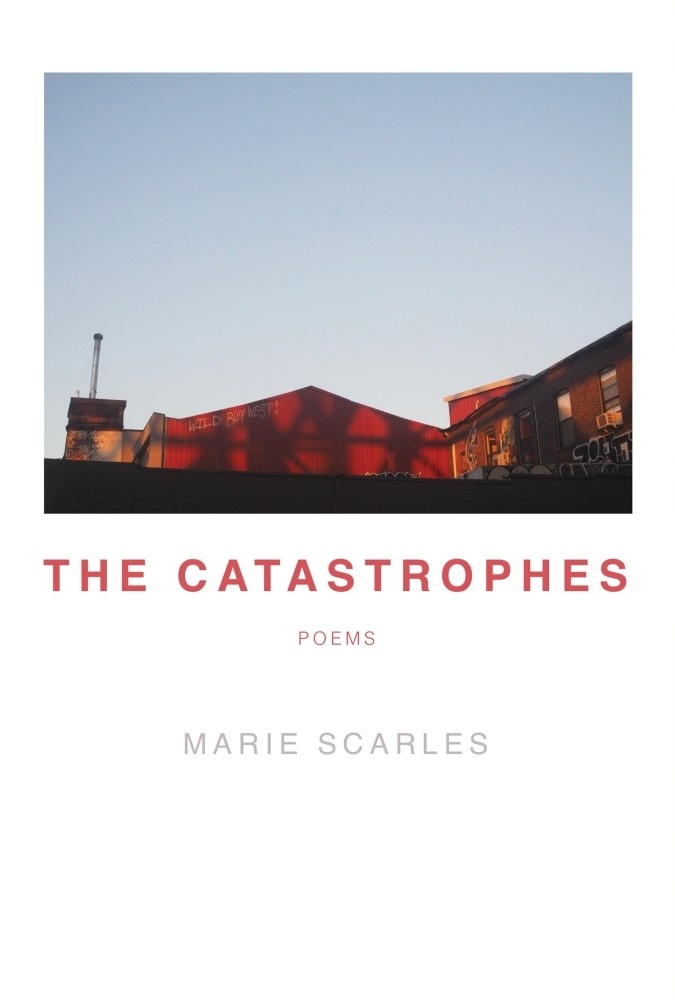
The Catastrophes
Marie Scarles
Finishing Line Press, 33pp., $17.99
Readers of The Catastrophes, a chapbook of poems which revolve around the place and space of regional Connecticut, will frequently encounter a satisfying blend of painterly imagism, documentarian fidelity, and subtly resonant use of ordinary language. Over the course of 24 poems, poet Marie Scarles uses this toolbox not only to represent actual landscapes on the page, but also to explore how their constraints, affordances, and incentives can be understood as lines which shape the course of human lives.
In “Flatbush, After Pain,” for example, Scarles uses short stanzas to chronicle several brief scenes of ordinary people—a driver, a florist, a cook, a pedestrian—before concluding: “three men in neon caps survey the railway’s iron lines / & the wooden ties binding them together.” The figure of ties binding “them” together may be interpreted as a reference to multiple literal antecedents; it simultaneously offers figurative meaning as a possible symbol of social cohesion, equity, or technology. These associations become more complex as Scarles returns to the motif of the line in other poems.
Many poems experiment with horizontal space and punctuation to provide readers with a visual sense of landscape on the page. In “Ongoing Colony,” couplets and single lines use both left indents and internal horizontal distance to evoke the physical space being described:
strip mall parking lot driveways
weeds jut through cracked rock
parched lawns
doves on the interstate guard rail, cooing
here ::
nuclear power plant
here ::
correctional facility
:: empty industrial town
two front teeth, missing
concrete ecology of big-box stores &
frozen TV dinners
:: ache of the 12-hour day at the refinery
penitentiary factory
Along with ample literal description, the speaker includes both figurative details (“two front teeth, missing”) and sensory details (“ache of the 12-hour day”) which supply the field of images with emotional depth. Scarles also augments her use of space by using the relatively uncommon double colon; the mark’s perfect rotational symmetry offers an open syntax which invites the eye to move both horizontally and vertically through the landscape of the page.
Scarles uses this foundation of represented landscapes to explain catastrophes in the lives of their inhabitants. One of the most haunting is “Brownfield,” subtitled, “Catastrophe of the Shale,” a depiction of “the towns around the drills” where “girls / go missing”. The speaker explicitly links the exploitation of the shale gas industry to the violent behavior of its workers, noting that “What a man / cannot master // masters him. Spills onto people / he can reach.” After further elaboration, the poem then closes by relating the idea of emotional or behavioral spillover to the concept of the line:
Under the bright lights of a boardroom, two men
clasp hands and shake. All spills begin upstream, the bottom
line throbbing. The line that breaks a man or woman
is mere runoff, the horizon, a flood of groundwater scum.
The horizon is a place where women
go missing. As if missing were a place to which one could run.
While the “bottom line” appears to be a simple reference to profit-driven decision making by those present in the “boardroom,” the second reference—to the ‘line that breaks” a person—is a more complex figure, a type of flow or causal force that moves through both land and body. Scarles’ portrait of abused and missing women operates at a scale beyond the individual, helping readers to contextualize one community’s catastrophe as a constituent element of the landscape’s complex web of relationships.
Another poem that uses the figure of the line to illustrate connection is “Pipeline,” subtitled, “Catastrophe of Extraction,” a pair of long stanzas that contextualizes everyday life. After a thorough visual description of the domestic landscape at morning, framed to emphasize the rising “plumes … of concrete and rust” of a nearby oil refinery, the speaker concludes the poem:
Every morning I haul my body up
and stand at the range, boiling coffee, plating eggs.
Plate, coffee, air, eggs: I survive on a filthy line. I breathe
what once seethed under the crust, and then—piped up—
I hold my cup.
The “filthy line” on which the speaker survives is productively ambiguous, prompting readers to draw their own conclusions about its meaning and possible referents. While its unclean quality is an apparent nod to the pollution caused by refining fossil fuels which are no longer “under the crust,” its linear quality leads back to the web of cause and effect extending from landscape to individual lives, in which extractive technologies raise both standards of living and health risk. Ending on a rhyme—a technique Scarles uses frequently—further engages readers with sonic metaphor. Rhythm and rhyme provide an unmistakable ending to the text, a moment that is felt before being understood as the culminating point of a syntax of relationships among phonemes. This is not unlike the small catastrophes in the lives of her speakers: acutely felt endpoints that are downstream of rhythmic interplay among vast causal forces.

Scarles takes care to integrate historical understandings of the landscape alongside her focus on contemporary working-class experience. In “Connecticut’s Last Commercial Fishing Port,” a single-paragraph prose poem, the speaker traces a line from the present state of disrepair, through the colonial heyday, to the land’s “first inhabitants, the Pequot and the Narragansett”. Later, in “Mystic, Connecticut,” Scarles uses an epigraph to inform readers about the “Mystic Massacre of 1637,” an event which “played a decisive role in shaping colonial and U.S. policy toward Native Americans.” The poem’s chilling ending offers a grim counterpoint to the recreational experience of “loafered tourists” by zooming in on the sand beneath their feet:
But beauty
hides as much as it reveals.
What came of them.
The women, children,
bodies hurled into
the river’s mouth?
Beneath the glinting
waters lie sand-
like granules of bone.
The image of the skeleton beach, composed of the bones of massacre victims from nearly 400 years ago, powerfully illustrates the unseen ways landscapes hold the past and bring it into the present. Scarles’ choice to contrast this truth of the land with the ignorance of visiting tourists is a pointed reminder that flows and forces beyond individual comprehension operate on their own terms.
Despite its trove of information about the land and history of Connecticut, The Catastrophes is not merely a place-based artifact for the local enthusiast. Scarles’ choice of title points away from place, and toward the book’s deeper and more powerful offering: a changed way of seeing, one of the hallmarks of any successful poetics. By showing readers how to view the land around them not as a disconnected and static externality, but rather as a dynamic series of “scenes I cannot be cleaved from,” as she puts it in “Ecotone: Southeastern Connecticut,” the poems in this volume provide a framework for tracing the lines of cause and effect that shape our lives.
About the Author
Marie Scarles is writer, maker, and movement worker from the marshlands of Mystic, Connecticut, living and working in Brooklyn, New York. Her poems, essays, and reviews have been published in The Believer, Los Angeles Review of Books, The Rumpus, About Place Journal, Swamp Pink, Quarterly West, and elsewhere.
In her past lives, she’s worked as an editor, educator, and server in many, many restaurants. Most recently, she was a lecturer at Rutgers University–Camden, where she taught critical and creative writing and served as the Media Organizer for the Rutgers Adjunct Faculty Union.
Contributor Bio
D.W. Baker is a poet, editor, and teacher from Saint Petersburg, Florida. His poetry appears in Identity Theory, ballast, and Sundog Lit, among others, and has been nominated for Best of the Net. He reads for several mastheads including Variant Lit and Libre. He serves as a Contributing Editor and Poetry Reader for Philly Chapbook Review.
Contents
Chapbook Poem: Slow Burn by Evan Wang
“The concept of personifying a slow burn deeply resonated with who I thought myself to be—a slow burn, love flickering around me.” Read the featured Chapbook Poem of the Month for April 2026, “Slow Burn” by Evan Wang, along with a few words from the poet.
Book Excerpt: She wants shimmering scales by Nicole Alston Zdeb
“The nexus of the erotic, the social, and the body felt relevant to what I was experiencing at the end of the 20th Century. There are glimmers of personal lore as well…” Read the featured Excerpt Poem of the Month for April 2026, “She wants shimmering scales” from The End of Welcome by Nicole Alston Zdeb, along with a few words from the poet.
“I wanted to explore how time was registered not only by the calendar and clock, but also in the various utilitarian tasks of my mother’s life.” Read three poems by Ron Mohring, our first biweekly poet of the Spring 2026 issue, along with a few words about “Fuse.”
Three Poems by Andrew Pelham-Burn
“Children in these circumstances are deprived of love at a formative stage and learn to immediately behave like adults without the benefit of the learning path of childhood.” Read three poems by Andrew Pelham-Burn, our second biweekly poet of the Spring 2026 issue, along with a few words about “Conkers.”
A Conversation with John deSouza
“Language is a powerful tool and can do great harm both to ourselves and to those most close to us when used cruelly or selfishly.” Poet John deSouza discusses his chapbook, This Rough Magic, his creative process, and the influence of John Ashbery in this interview with editor Danielle McMahon.
Chapbook Poem: from Stray Hunter’s Bullet by Lance Le Grys
“…what interested me was the idea of a character who didn’t do what he was capable of, not because of external circumstances, but because of either a lack of will or a seemingly perverse one.” Read the featured Chapbook Poem of the Month for May 2026, from Stray Hunter’s Bullet by Lance Le Grys, along with a few words from the poet.
Book Excerpt: Love does not exist by Maria Giesbrecht
“This poem was inspired by a dream… I had this strange feeling when I woke up that it meant something more and started writing a poem to see if anything would reveal itself to me.” Read the featured Excerpt Poem of the Month for May 2026, “Love does not exist” from A Little Feral by Maria Giesbrecht, along with a few words from the poet.
“After a loss in my family, I discovered one grieves for both the living who hide their pain and for the dead who sleep in silence.” Read two poems by Patricia Wallace, our third biweekly poet of the Spring 2026 issue, along with a few words about “Fox.”
May ’26: New Staff, New Calls, New(ish) Name
Editor Aiden Hunt provides information about changes to PCR’s name, format, and staff in this editor’s note, which also contains links to our Spring calls for submissions.
“I kept thinking about how easily adults learn to stop seeing what’s right in front of them, especially when they’re somewhere between one country and another, neither arriving nor leaving.” Read four poems by Nivara Lune, our fourth biweekly poet of the Spring 2026 issue, along with a few words about “Notes Toward an Elsewhere.”
The Lines of Landscape: on The Catastrophes by Marie Scarles
“Scarles’ choice of title points away from place, and toward the book’s deeper and more powerful offering: a changed way of seeing, one of the hallmarks of any successful poetics.” Read the full chapbook review by contributing editor, D.W. Baker.
“Every time I plucked a few of the little orange sun sugars to take inside, their garden smell lingered on my fingers. It was almost enough to just sit with that scent…” Read three poems by Kait Quinn, our fifth biweekly poet of the Spring 2026 issue, along with a few words about “The Tomato.”
Chapbook Poem: Superbloom by Joyce Schmid
“That June, flowers bloomed everywhere in Northern California—as if to honor her, to celebrate her life. This poem is an attempt to accept the fact that she is really gone.” Read the featured Chapbook Poem of the Month for June 2026, from Superbloom by Joyce Schmid, along with a few words from the poet.
Book Excerpt: The Well by Robin Becker
“Allowing flickering sentiments and images to play against one another, I replicated one form of consciousness. A surprising aspect of the poem: the sudden appearance of figures of government.” Read the featured Excerpt Poem of the Month for June 2026, “The Well” from Midsummer Count by Robin Becker, along with a few words from the poet.
“Like a lot of my poems, this one reaches toward something impossibly out of grasp. But … maybe that’s the power of a poem, to momentarily touch something out of our reach.” Read three poems by Scott Weaver, our sixth and final biweekly poet of the Spring 2026 issue, along with a few words about “Annotating The Inferno.”
A Conversation with Abby Minor
“[A] long time ago I realized, and more or less accepted, that I would commune with most of my poet teachers and comrades via their work, not in person. And my work is how I talk to them.” Poet Abby Minor discusses her chapbook, Infinity Ballot, her Jewish-Appalachian heritage, and her convictions in this interview with new contributor, Julie Swarstad Johnson.