
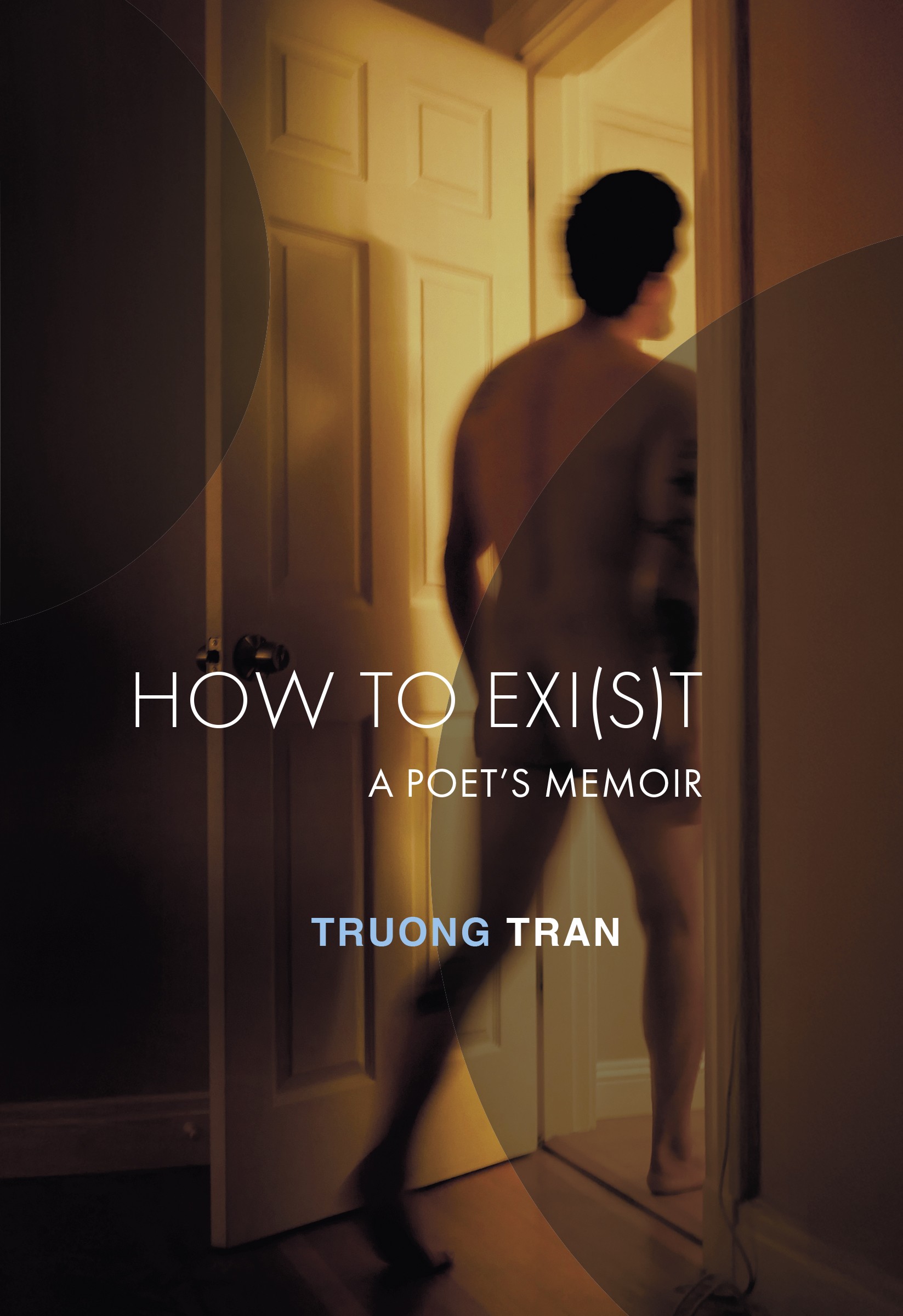
Philly Chapbook Review is pleased to present an excerpt from How to Exi(s)t: A Poet’s Memoir by Truong Tran, due out from City Lights Books in October, 2026, as part of the Summer 2026 issue.
The book focuses on Tran’s difficulties and different ways of seeing as a result of existing at the intersection of various fraught identities: gay man, immigrant, refugee, poet, writer with dyslexia. As PCR Reader Amanda Simonson comments, the following excerpt shows Tran’s “struggle between writing in prose and reverting to poetry” including “his exploration of growth and belonging” despite a deficient educational system. Positing a reading of the title of Tran’s book, Simonson notes that the author “can either exist, by learning despite the systematic failures he experienced, or he can exit by refusing to explore the past.”
On dyslexia or wtf
I grew up in a different time, where I, as an immigrant kid, was all but grown up by the time I was eight. I cooked the family meals by 10, not as a chore but of my own choosing and curiosity. At the age of 12, I was already reading straight erotica and reinterpreting it as gay. All this happened because I was dyslexic. My hope in writing this is that I find my way back to the statements I just made, but that would imply that I actually know where I’m going.
I was never diagnosed with anything more than a cold. I wouldn’t receive a diagnosis of dyslexia until I was 40, but I asked that it not be documented, for fear of it being used against me as a teacher. But as a kid, I convinced myself that I was just different, in both existing and understanding. I can say this now with some semblance of confidence, but I did not know it back then. How could I have known? My parents never asked to see my grades. They never said what they expected, but still, they expected that I would go to college, take out loans, and pay my own way towards a better life. That was the base thinking of all things moving forward, that my life was going to be better than the life that came before. But how was I to do that when I could not comprehend?
It took me three times as long to read a chapter of any given textbook. I would stay up all night reading and rereading, only to arrive at not knowing what it was that I had just encountered in words. Language was a nonsensical kaleidoscope of letters and sounds and interrupting images. I never told anyone of my dilemma. Or was it dyslexia? In fact, I did not know of this condition or the term until I thought it was too late. I was in college. I declared my major as Comparative Lit. This was in fact a default decision. I couldn’t do science or math or anything that required the deciphering of language. Interpretation was my only option.
In college, I learned how to get by, how to stay above average but never so high up that I would ever be seen. My life in language was about adaptability. I could never keep up with the assigned readings of a class. A book per week per class in a semester of at least four classes as a full-time student meant that I would have to read, at the very least, 20 books in a semester. That was insane and not humanly possible for someone like myself. Adaptability demands creativity. This meant that I would not read a book in its entirety. I would latch myself to a point in the book, state my argument, and doggedly argue that point to a halting conclusion.
A course on Jewish American Literature became a heavy-handed comparative study of the Vietnamese refugee experience. Bible as Literature became Jesus as E.T., where Elliot and Greg and Tyler and Steve were all disciples. There was betrayal and persecution, death and resurrection. I made a case for then-child actress Drew Barrymore as Mary Magdalene. That was a reach, even for my imagination. I made the argument, nonetheless. I got a B−. I graduated from college with just enough, a second-place prize, a publication, to get into grad school.
I chose poetry, again as default. The books were short enough to read, to write if I had to. One day I’ll have to, I told myself. Maybe for once, I could get through a book in its entirety. The idea of moving from front to back, from cover to cover was a strange and secret goal for me as a grad student, wanting to be a writer. Adaptability was all about planning, adjusting, doing what you can, and faking what you can’t. Creativity and innovation became the catch-all receptacles for my movement through this life of writing and pretending to read. It became my way of hiding my dyslexia or, perhaps more appropriately, denying its existence.
My lack of comprehension of the workings of grammar became the basis of a grammarless writing praxis. My inability to adhere to the tenses of the English language—Vietnamese verbs do not conjugate—became claims to exist simultaneously in the realities of the past, present, and future. The jumbling of language in a poem became a deliberate syntactical choice. What was forgotten on the page became the absence of language. The institution taught me how to be silent. I embraced such teachings. I took shelter in the concept. I hid inside. I convinced myself of this work I was doing, this work of silence, of protest, of shame. I hid this last part even from myself. I am only now finding a way to say this.
How does one exist as a writer when one is filled with the dread of reading? How do I say any of this without feeling like an imposter or sounding like I’m crazy or just trying too hard to be some sort of literary other? Just this morning, I tried to read a chapter from a book. I caught the meaning in bits and pieces and took it upon myself to piece together some imagined understanding. Is this what it means to be dyslexic? To arrive at meaning is always having to risk the vulnerability of interpretation. Is this enough to bring us back to the statements made at the beginning? Was I a grown man at the age of eight? Did I feed my family by the time I was 10? Was I really addicted to porn at age 12? Do I blame this on a condition? Do I diagnose this as living?
On the insistence of a future
Why all this effort to write about the past? I am trying to reach for something. I am trying to write beyond my present state of hopelessness. I keep on looking towards a future, but again present conditions lead me to think that there is no hope to be found. The world is burning. This is not hyperbole. At school, children are taught to hide behind doors and under desks, to practice being silent, and to pretend to not be present if the shooter is present, beyond the classroom door. Once we teach this to our children, this drill, I’m afraid the shooter will always be present.
I am comparing my memory as a first grader to that of my godson, now at the same age. There is an innocence and hope in his exultation of the new school year and his new teacher, who does not yell, “Not one bit,” he says. I am told by his mother that he has not yet been taught to fear the shooter. I am afraid that this fear will find its way into the thoughts of every child.
My memory of first grade has been reconstructed as trauma, that loving gesture of my teacher who took the liberty to dress me up as the Indigenous other, because she could not help but see an “other.” I shared a similar exuberance to that of my godson when I came home and told my mother that I was going to be an Indian in the school’s Thanksgiving Parade. Trauma perhaps is the act of looking back and seeing race as an enduring way of life, and still, there was something beyond the trauma that was tucked deep inside.
Why all this effort to write the past? I’m going to be a writer right about now and say that my body is a time traveler. It has a way of knowing the future. It knows just when to take a moment, convert it to memory and tuck it away, and when to dislodge it from within, from the past, as poems and stories and essays and art. Somewhere in these stories of past and otherness, there is the story of wanting and belonging. I still want to belong to a world that is still wanting to be better than what it was and what it is. That’s why. And I want it for my godson, whose latest thing is superheroes—that and the promise of matzo ball pho.
On the puzzle still inside my head
In writing about the past, my childhood education or the lack thereof, my fated path to where I am, to who I am, I am thinking about the ways in which I navigated my way here, the constant self-questioning of when to speak up and when not to speak, when to invoke the performance of otherness and when to accept when I’ve been cast in the role of the invisible, or the countless times I pretended to know, hoping that no one would ask for proof of my knowledge.
*
When I was growing up in the seventies as a newly arrived immigrant, there were two possibilities. You were either smart and celebrated in your status as a model minority or you were stupid and a thug. How those words and their characteristics found affiliations begins with a willingness to see or in most cases not to see. There was no spectrum to locate, time to bother, or index to help in identifying.
*
To an immigrant family still consulting the pages of a dictionary, ours was the language of necessity, of this and that. The word “living,” an adjective, sat on a page dog-eared for good reason. The reality in my home was simply this. My parents couldn’t name what they didn’t know. A diagnosis meant being told by the dentist that your child needed braces and the diagnosis that followed was that we couldn’t afford them. Sorry, kid, you’re shit out of luck.
*
This need to write about the past and my lack of education, how it is that I became a writer, more specifically a poet. One of my students once sent me a note of thanks. In it, she wrote, “Thank you for teaching me how to lie, cheat, and steal my way into the academy.” If only someone could teach me how to cheat, steal, and lie my way out of this damn house, I would write them a note in actual sentences. I would thank them profusely and definitely cook them dinner.
*
To write about the present moment. To think that my identity, and how I came to see myself, were perhaps a path paved as a series of defaults. I had no choice, no real say in the matter. I couldn’t read science or history or math, so I settled on literature. What I didn’t understand, I just imagined. I got off the bus, I mean the book. I chose a point and argued that point until it seemed as though I knew. Just don’t ask me about what happened at the end. I never made it to an end.
*
I could never write a series of sentences, like what’s happening right about now. So I wrote lines. I wrote poems. I claimed it was an aesthetic choice, an artistic assertion, and a political stance in the English language. Some of that may still hold true. Most of that was the undiagnosed condition of coping as default. I swear on a stack of unread bibles, this is an essay. It is an attempt. For the first time ever, I’m trying to say . . .
*
I’m doing it again. This essay keeps wanting to be a poem. This sentence is written as documentation. The subject wants to hide in language. This essay wants to be read with clarity. This subject needs to be brought to light. This is dyslexia. This is poetry. It’s not supposed to be a poem. This is dyslexia being enacted even as it is being written.
*
Why now? Why the need to write this now? I have this puzzle still inside. The pieces are stuck inside my head. I’m doing it again. That thing I do when trying to make sense. It’s five thousand pieces. The number keeps changing. It’s been sitting there all this time. For some reason or another, I cannot seem to throw it out. Perhaps the reason is still inside, that thing I do with the imagination.
*
I am writing this book. I am constructing this table. It’s big enough to spread out the pieces. It’s just a matter of doing this work of piecing the fucking pieces together. The numbers keep changing. The words keep changing. This is not the act of circling back, to claim what was lost or to name what was found. Neurodivergence. That’s a good word. I’ll save it for this generation. The next will have their own way of saying. But as for me, I’m good for now. Then why now? Why the need to write this now? Because this puzzle needs tending to. Because I just need to know this for myself.
On dyslexia and the imagination
What if I told you that I am a writer who did not love literature or poetry, although I did arrive at a kind of love, like loving a pair of shoes given and received as hand-me-downs. They were a little too big and not the right color but with some time, blue, green, and yellow felt markers, wearing-in, waking up to the imagination, they shaped and molded themselves to the contours of my feet in the same way that words and language shaped and molded themselves to the contours of my being. What if I told you, the act of reading a sentence renders the sentence that came before incomprehensible. What if I told you that there is wonder in not knowing. You make things up as you go along. This leads me here to what I am about to say. This is what I’ve always known. This is who I really am, the default of who I cannot be. Just so you know, this is not an excuse. This is not arriving at a confession. This is a reclamation, a declaration. This is a love letter to everyone who learned the art of faking it, who never made it to the end of the book because reading for them was not and could never be linear. I made up my world along the way. A world of storms and whirling winds that insisted on living in a state of aftermath. Is it any wonder that I survived one shitstorm after another? That is to say, that racism and queerness and trauma and discovery all exist inside this book, in proximity to one another. What if I told you that dyslexia was not a condition that led to coping, but rather an innate ability to survive and sometimes even thrive?
About the Excerpt
The narratives found within this book were first written as essays. And the essay, by its very definition, is an attempt. I am trying to excavate memories. I am trying to negotiate the difficult realities of existing as a brown man in this country and within the consciousness of white America. Did I succeed in my efforts?
This book is a chronicling of both the overcoming and the failures of what it means to exist while also looking for a way to exit the limitations of my existence.
That which does not kill us allows us to wake up to yet another day, and for that, I am grateful. For my existence. And yet, I am still looking for an exit strategy.
Contributor Bio
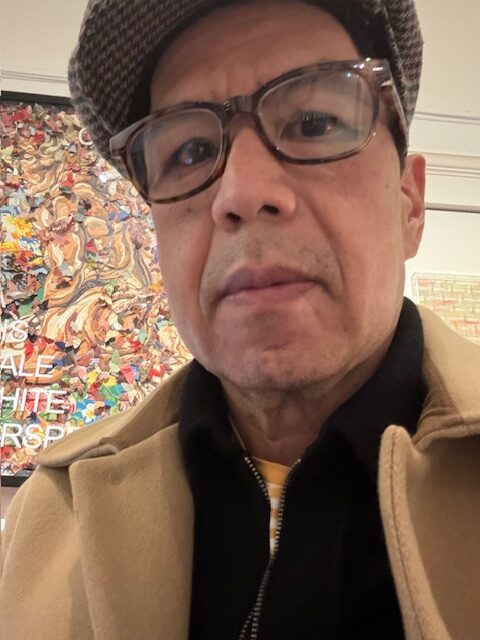
Truong Tran is a poet, visual artist, and teacher born in Saigon, Vietnam. His book-length poetry project Book of the Other: Small in Comparison (2021) received an American Book Award in 2022. He is the author of seven other collections, The Book of Perceptions, Placing the Accents, Dust and Conscience, Within the Margins, Four Letter Words, 100 words (with Damon Potter), and Looking and Seeing/Seeing and Looking (with Damon Potter). He also written the children’s book Going Home Coming Home and an artist monograph, I Meant To Say Please Past the Sugar. His poems and books have been translated into Spanish, French, and Dutch. He is the recipient of the Poetry Center Prize, the Fund for Poetry Grant, the California Arts Council Grant, and numerous San Francisco Arts Commission Grants. Truong is also a visual artist who believes that art, be it poetry, cooking, sculpting, and even gardening, are his ways of thinking through the conscious of the times we live in. Truong lives in San Francisco and currently teaches at Northeastern University, Oakland.
from How to Exi(s)t: A Poet’s Memoir
How to Exi(s)t: A Poet’s Memoir is an experiment in nonlinear autobiography by the author of the American Book Award-winning Book of the Other, Truong Tran. Beginning in the present–at a writing residency in the aftermath of this success–How to Exi(s)t moves back and forth in time, in bursts of brief poetic essays grouped by theme. The duality of the title thematizes a dilemma at the heart of the book: how does a poet separate himself from the academic career to which he’s devoted his professional life and what does being a teacher mean outside of it?
Unpeeling the layers between present and past, Tran proceeds in reverse as he explores crucial events and figures in his life, including the reaction to the publication of Book of the Other, the dynamics of whiteness and power framing his repeated rejection for a tenure track position, the profound effect of his dyslexia on his evolution as a writer and artist, the repercussions of being outed by a newspaper after winning an undergrad poetry prize, traumatic episodes growing up in the Vietnamese diaspora in San Jose, and complicated relationships with both his family and his chosen family. Attempting to fathom these experiences and connect them to his present self, Tran examines and reexamines key details rather than dispensing with them in neat anecdotes, reflecting the volatile process of imagination and memory.
Unsparing, even caustic in its instance on racism as a dominant note of American life, but marked by surprising tenderness and humor, How to Exi(s)t is a compelling portrayal of Tran’s pedagogical philosophy as well as an interrogation of a poetic language that conceals as much as it reveals.
Available on October 6, 2026: City Lights Books
Credit: Truong Tran, “On the insistence of a future”, “On dyslexia or wtf”, “On the puzzle still inside my head”, and “On dyslexia and the imagination” from How to Exi(s)t: A Poet’s Memoir. Copyright © 2026 by Truong Tran. Reprinted by permission of City Lights Books, www.citylights.com.
Contents
“This language offers one possible framing through which to appreciate the law’s capacity to hope for, request, and even command commitment to a more just future.” Read two poems by Maggie Wang, our first biweekly poet of the Summer 2026 issue, along with a few words about “Possibilities for Action.”
Chapbook Poem: I’ll Never Look This Good Again by Douglas Piccinnini
“[The poem] came out of real pressure: despair, worry, and grief I wanted to hold unflinchingly, alongside the anxiety of becoming a parent… For me the poem became a meditation on all the feeling that surfaces precisely when we’re told to feel only joy.” Read an excerpt from Douglas Piccinnini’s chapbook, House of Bad Memories, along with a few words from the poet.
“She sees herself in carbon, the element that bonds with almost anything- not because it wants to, but because it has empty spaces and things keep showing up to fill them. Notifications. Noise. Needs that never stop arriving.” Read four poems by Joely Williams, our second biweekly poet of the Summer 2026 issue, along with a few words about “Single Mother Considers the Periodic Table.”
ADHD in a Non-ADHD World: on Undersight by Alison Hurwitz
“[Hurwitz] shares moments of angst and moments of awe. More than that, there are moments of deep recognition. She sees herself in [her sons] and, in fact, receives a later-life ADHD diagnosis of her own.” Read the full chapbook review by new contributor, Nancy Murphy.
“The woman’s head & hair are lavishly dressed. I probably leapt off the logic of the hairdresser being blind and therefore had to work on the head/body/mind rather than just hair as a surface issue of presentation.” Read two poems by Irene Cunningham, our third biweekly poet of the Summer 2026 issue, along with a few words about “The Blind Hairdresser.”
Flash Fiction: Nova by Kimmy Chang
“‘Nova’ is a lyrical second-person story about the narrator’s first true encounter with death…the story presents loss not as beautiful in itself, but as the place where beauty begins.” Read the first original fiction piece of the Summer 2026 issue, “Nova” by Kimmy Chang.
“To fit the nuanced, dimensional experience of dysphoria and transition into narrative…often feels flattening, falsely assured. I wanted to look at this discomfort I felt, to see what was necessary in it.” Read three poems by Joshua Zeitler, our fourth biweekly poet of the Summer 2026 issue, along with a few words about “Cobbling.”
Excerpt: “On the puzzle still inside my head” by Truong Tran
“I am trying to excavate memories. I am trying to negotiate the difficult realities of existing as a brown man in this country and within the consciousness of white America.” Read an excerpt from Truong Tran’s forthcoming book from City Lights, How to Exi(s)t: A Poet’s Memoir.
“These poems try to make sense of how I arrived at a life that probably seems well thought-out, but has been one reactionary choice after another.” Read three poems by A.R. Dugan, our fifth biweekly poet of the Summer 2026 issue, along with a few words about “Sleeptalking.”