

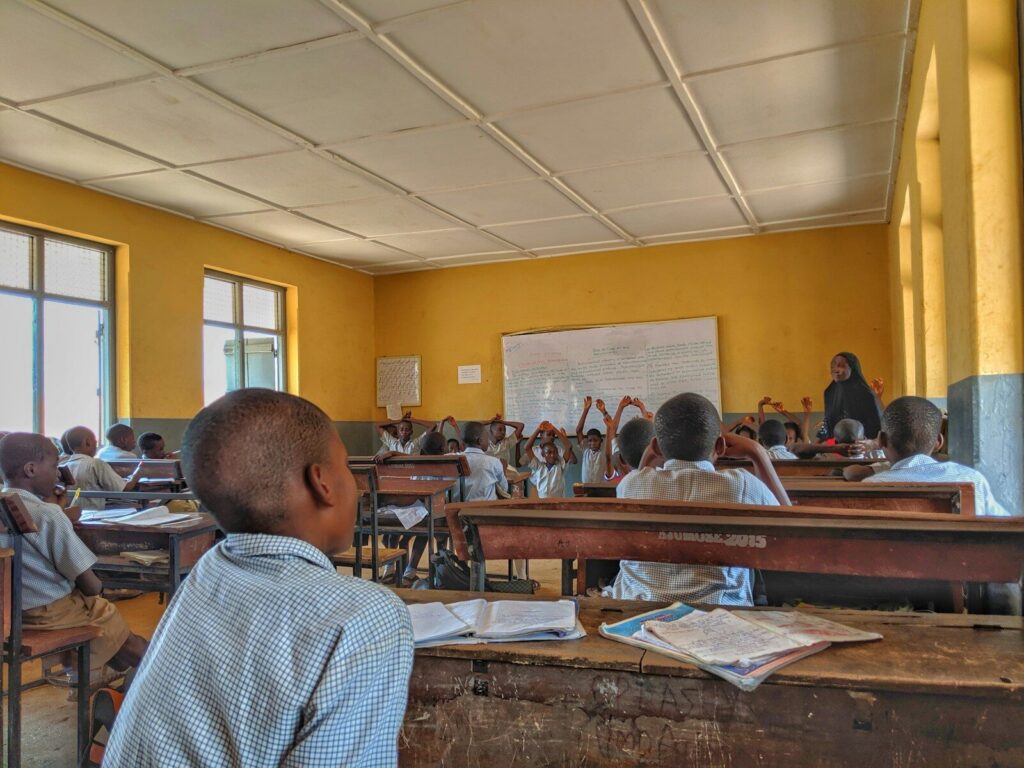
Philly Chapbook Review is pleased to present second piece of original fiction for the Summer 2026 issue, “Muse” by Somtoo Celestine Ezioha.
Muse
Dearest Mmesoma,
I saw your engagement video at 11:47 p.m. on a Thursday.
Adaeze was asleep in the next room. I could hear her breathing. Slow, settled. She had a difficult case review at the hospital. She was tired before dinner. By ten, she was gone.
I was on the bathroom floor, back against the bathtub. That’s where I go when I need to think without waking her.
I had typed “Congratulations!” in your DMs. The exclamation mark looked wrong. I deleted it. Just “Congratulations.” That looked worse. I deleted it again. The cursor blinked in the empty text box.
I opened my notes app instead.
I don’t know what this is. I don’t know if it’s for you or for me. I don’t know if I’ll send it. Most things I mean to say just stay with me.
But I’m going to write it. Because you’re getting married, and I’m sitting on a bathroom floor at midnight, and something in that combination deserves to be looked at.
You have to understand Onitsha to understand anything about me.
The city starts before you finish sleeping. By four in the morning, the buses are moving. By five, the market women are arguing about stall positions. By the time I was up and dressed for school, the street outside our house was already in full conversation: horns, the grinding complaint of a tricycle engine that had lived past its warranty, someone calling a greeting across the road that didn’t need an answer but always got one.
My mother’s radio was on in the kitchen. She cooked to music I never learned and couldn’t name now if you asked me.
I was the child who registered all of this without joining it. I stayed inside, where the books were.
The library at St. Augustine’s Primary School was a converted classroom, the fourth room after the headmistress’s office, which smelled of Madam Ngozi’s perfume whenever you passed her door. The library smelled older. The books had pages gone soft at the corners, ink that had been in them long enough to become part of the paper.
Mrs. Abadom had arranged the shelves so the novels were nearest to the window. She told me once, unsolicited: light matters when you’re reading something good. She knew what I wanted before I had words for it. She pressed books into my hands with her opinions already formed. She once told me a novel would make me cry and then added, “Don’t bring it back with water stains.”
Every break period, I was on the floor near Mrs. Abadom’s window, cross-legged, reading. My classmates were outside. I could hear them through the louvers, the pitched squeal of a game I no longer remember, a ball hitting a concrete wall. I would look up sometimes at the outside sounds. Then I would look back down.
You were always out there, during those breaks. I knew this without having to verify it. You were never in the library when I was. I noticed it more than I should have.
There is something I should say about the boy I was in that room, so you understand the rest. He was a boy who had found, earlier than most, that a novel’s interior was more generous than his own life’s, and he kept returning to that generosity because the library was one of the few places that had never refused him. The library gave him worlds. The worlds gave him a vocabulary for feelings he did not yet have the right names for. He thought, for a long time, that this was enough. That it was a complete thing to feel something in language and never say it aloud.
We were rivals before we were anything else.
The first position in class rotated between us across six years of primary school. In the third term of Primary Four1, you came first by four marks. I spent a week on those four marks. In the second term of Primary Five, I came first by two. I remember watching the back of your head during morning assembly that week. You didn’t turn around.
I noticed other things. The way you carried your bag on one strap, always, even though it was heavy enough that you tilted slightly right when you walked. When you were thinking something through, you stopped moving completely. Hands flat on whatever surface was near. Eyes fixed somewhere that wasn’t the room. When you argued with teachers, you were never loud. Always clear. They ended up feeling the answer had been their idea.
I told myself I was studying a competitor. That was the only frame I had.
Secondary school, and the feeling became something else.
By JSS3, what I felt watching you in class had outgrown competition. It had edges. It was the kind of wanting that loops back on itself, with no target beyond its own continuing. You had a way of moving through the world with a lightness I kept trying to understand and never quite did. Our names still appeared near the top of every results board. But the board was no longer what I was looking at.
You sprained your ankle coming off the track during SS1 inter-house sports. I walked with you to the sick bay; you didn’t ask me to, I just started walking. We talked the whole way about something I can no longer reconstruct. What I remember is the quality of the talking: easy, unrehearsed, the kind that doesn’t work unless both people are already comfortable. At the sick bay door, you said, “You didn’t have to.” I said it was nothing.
I had, by then, built up a catalog of things about you that I would not have been able to explain. The fact that you always read the last page of a novel before you started it, which I discovered when I caught you in the library once during a free period, turning to the back of a book before opening to the front. The way your handwriting changed depending on whether you were writing for a teacher or for yourself: formal for them, quick and slanting inward for you. The fact that when you laughed, really laughed, you went a few seconds past where most people stop. I knew these things. All of them. More than I had meant to know.
The year after that, a senior boy said something to me in the corridor, unkind, the unkindness of someone with a year or two of age advantage who thinks that’s enough, and you were within earshot. You turned. You said to him, at normal volume, in the voice you used when an argument was already over: “Mind your business.” He minded it.
That was you, the defense without being asked, and then the very same afternoon, a snap at me in the corridor because I’d said something you’d already heard. “I know. I heard you the first time.” And you walked ahead.
I wasn’t annoyed. Even then. I don’t know what that tells you about me.
Mrs. Orji’s English assignment was simple: write about something you had seen that week.
The others wrote about television, football, what someone’s uncle had said at dinner. One boy wrote three careful lines about the rain and four more about the bucket that collected the rain, as though the bucket were the story.
You wrote about your mother in the Onitsha Main Market.
You stood to read. The room settled before you said a word. You wrote about the inside of your mother’s market stall: her hands sorting peppers, the speed of it, the sound the rejected ones made hitting the crate. You wrote about a price negotiation. Both parties already know where it ends. They complete it anyway. The completion is the respect. You read a line with the word “orange” in it and something about the smell that followed your mother home, and the class laughed. Real laughter. Recognition laughter.
Mrs. Orji said your name once, quietly, like a verdict she’d already reached.
I caught you walking out. I said, “That was really good.”
You looked at me. One moment. “I know,” you said. And turned away.
Competition had rules. I knew those rules. There was a board, there were marks, and there was next term. What I felt when you said “I know” and turned away had no rules. Being seen and then made invisible in the same moment. I had no frame for that.
Two weeks before that, Mr. Eze had told the class I “read too much and thought too little.” You turned around in your seat before I could respond. You asked him, in that flat way you had, what exactly was wrong with the reading.
He backed down. You turned back to your desk.
That same afternoon, in the library, I tried to tell you about the novel I was going through. You said, without looking up, “I’m thinking.”
I sat back down.
What I didn’t understand yet was that I loved both of those things equally. The public defense and the private dismissal. The fire turned outward, and the flat refusal to pretend. I had no idea what to do with loving both of those things, so I did what I always did with things I didn’t know what to do with: I read more books and said nothing.
By the time secondary school was done, I had spent years confusing watching someone with knowing them. I had made you into a fixed point I circled. I never closed the distance.
I also had notebooks. Two by the end of JSS3, four more by SS3. Nothing in them was finished. Pages of starts, the first sentence of something I would then put down to go back to whatever I was reading. I wrote about everything except the things that mattered to me. That is the only honest thing I can say about those notebooks.
My father’s vision for me was already settled before I had a say in it. The sciences, always. Medicine, ideally. He had watched me read every book in that converted classroom library and concluded, I think, that a person that fond of information should be in a profession that uses it. I said I wasn’t sure about medicine. His face went quiet, and he aimed his eyes at the table. We settled on Pharmacy. He paid for my application with money he had been setting aside.
I got into university. Pharmacy. I was good at it. Memorization and pattern recognition; I had always been able to do those things. I was not interested in any of it.
I kept the notebooks. More of them now, bought from the university bookshop. Still nothing finished. I would get a few pages into something and hit a wall I couldn’t name, stop, and open a novel instead. The same wall I had been hitting since primary school.
This was the other thing I was circling.
In university, during my second year, I finally told someone. Uchenna. We were in his room, studying for an exam neither of us was ready for. I said your name before anything else.
Mmesoma, from St. Augustine’s in Onitsha. We traded first position for six years. She goes very still when she’s thinking. I cannot read certain sentences without hearing them in her voice first. I sent her money last month. Two thousand naira. I had three thousand to my name that week. I still don’t know why I did it.
Uchenna put his pen down.
“You sent her two-thirds of everything you had.”
“She needed it. School project.”
He said, “She needed it. You needed her to know you’d send it.”
I didn’t argue. He was right. It wasn’t generosity. I had been hopeful. Which is a different thing. You messaged me two days later: “Got the alert, God bless you.” Then you asked if I’d seen a show I’d never heard of.
Two thousand naira. A blessing. A subject change.
You didn’t see me that way. I knew this. I had known it long enough to be tired of knowing it. But tired and done are different things, and I kept checking anyway.
Third year, you called me on a Tuesday night.
You had been crying; I could tell from how hard you were working to sound normal. Your boyfriend at the time had said something that unmade you, and you needed to talk it through.
I knew, by then, something of what I was to you. Earlier that year, a message I sent had said more than I intended. You received it carefully, kindly, and did not address it directly. We settled back into what we were without speaking about it.
So when you called that Tuesday, you knew. And you called anyway.
I listened for an hour. I said what you already knew: that what he said about you was not true, and that you didn’t owe him a version of yourself he couldn’t read. You thanked me. You sounded better by the end of it.
After we hung up, I sat in my room and thought about what I had just done. I had meant every word. I also knew that if you had called to say things were wonderful, if you had called to tell me about a trip you were planning with him, I would have listened with the same attention. The same care.
That was the thing I was slowest to understand about myself. I wasn’t waiting for you to be unhappy so I could step in. I just wanted to be where you were. Whatever that looked like.
I called you on a night in October, eight years after secondary school.
I was twenty-six. I was doing hospital rotations as a pharmacist. The career I had walked into because of my father’s face when I mentioned writing. He didn’t argue. He just went quiet and looked at the table. I was present. I was functional. I was wrong for it.
I was at my desk. My notebook was open. I had written your name twice in the margin without noticing. My old Tecno phone sat on the desk with the cracked corner of the screen I’d been meaning to fix since January. I dialed before I had fully decided to.
You answered on the second ring.
“Chibueze!” The warmth in your voice was exactly as I remembered it. Unchanged.
We talked about Onitsha. Mrs. Abadom, who had retired. Your mother’s stall, which had a second table now. We moved through shared references without pausing, trusting that nothing had shifted.
I said, “I’ve been thinking about you. For a long time.”
You went quiet. Long enough to mean something. Short enough to still call nothing.
“Chibueze,” you said. “I know. I’ve always known.”
That was not what I had prepared for. I had prepared for confusion, or gentle redirection, or some version of what do you mean. Your not-knowing had been load-bearing. While you didn’t know, nothing had ended. I was still in motion toward you.
Your voice was careful. Kind. You had thought about how to say this.
Silence.
“Mrs. Abadom. Did you hear she’s living with her daughter now? In Awka.”
I said I hadn’t heard.
“People say she looks well.”
We talked for four more minutes. I told you I had to be in by six; the drive was long. You said take care of yourself.
I said I would.
I hung up and went to the balcony. The neighbor downstairs was playing music with too much bass. Someone on the street was laughing. An okada passed.
I sat there for a while. I wasn’t crying. I want to be clear about that. I don’t know why I want to be clear about that, but I do. Just sitting. Thinking about the two thousand naira. Thinking about the four marks in Primary Four and the two marks in Primary Five. Thinking about the years of watching you from distances I had chosen and then resented myself for choosing. Thinking about the fact that you had always known. The whole time. And had said nothing. And I didn’t know whether to be grateful that you had been kind enough to say nothing, or to be angry that the kindness had cost me years.
Both, probably. Both.
I went inside. I opened a new document on my laptop. I had no idea what I was going to write. I only needed the cursor to be blinking.
That document became the first thing I ever finished.
It wasn’t good, if I’m being accurate. But it was complete, and it was mine, and it had an ending. I had never made anything with an actual ending before.
I kept writing after that. Three years alongside the rotations: at night, on lunch breaks, on my phone during the long silences that hospital work is full of. I wrote about Onitsha, about the library at St. Augustine’s, about people I had watched and never moved toward. I wrote badly, then less badly. At some point, I can’t precisely locate, a nurse I worked with, Nkiru, told me she had put down a piece I’d sent her halfway through because she needed a moment.
That was when I understood what you had done in Mrs. Orji’s class. You had looked at your mother’s hands, at the market, at the perfectly ordinary thing right in front of you, and turned it into something another person could feel.
I have been learning how to do that ever since. I am still learning.
There was a night in November, the third year. A man came in at 2 a.m. to pick up a prescription he had been trying to fill for 3 days. I filled it. He left. I stood at the dispensing counter for a long time after he was gone. The fluorescent light above me had a flicker nobody had fixed in months. I thought: I am a writer who is also a pharmacist. And then I thought: no. I am a pharmacist who writes. I couldn’t stand the second thought.
I left at twenty-nine. I haven’t gone back.
I’m still on the bathroom floor. My back is getting stiff.
Your engagement video is still on my screen. The man in it keeps touching your arm, your shoulder. Small, repeated touches. He still looks a little surprised. You’re laughing at something off-camera. The same laugh. Completely unchanged. Nothing has taken it from you, and I don’t think anything will.
I have been sitting here trying to figure out if what I feel right now is grief. I don’t think it is. Grief requires a loss, and I never had you. What I had was the idea of a future that was never offered to me. But there is something I can’t find the right word for in watching the life you built without me, and recognizing that it is a good life. That you deserve it. And feeling, at the same time, some residue of the boy who once sent you two-thirds of everything he had and waited for a response that was never coming.
Adaeze called my name from the bedroom. Just loud enough. She does this when she’s half-asleep and making sure I still exist in the apartment. She has known since the beginning that I go quiet sometimes, that there is a version of me that disappears into rooms. She has never asked me to account for it. She asks only that I come back.
“I’m here,” I said.
I am.
I don’t know what to call what you are to me now. The closest I can get is a room in a house I used to live in. I remember where the light came in, the particular way afternoon sounded in that part of Onitsha. But the house belongs to someone else now. That’s right. That’s correct.
Your name is in certain sentences. It always has been. I don’t think that’s going anywhere.
The WhatsApp tab is still open. The text box is still empty.
Congratulations.
I closed the app.
“Are you coming?” Adaeze called from the bedroom.
“Yes,” I say. “Coming.”
I don’t know if I’m done.
Chibueze.
- In Nigerian parlance, Primary School is the equivalent of U.S. grades 1-6, Junior Secondary School (JSS) is grades 7-9, and Senior Secondary School (SS) is grades 10-12. Thus, “Primary Four” is the fourth year of Primary School. Likewise, JSS3 and SS1 refer to the third year of Junior and first year of Senior Secondary School, respectively. ↩︎
About the Story
I wrote ‘Muse’ because I wanted to tell the truth about a particular kind of love. The kind that never quite begins. The kind you carry for years without fully understanding what you’re carrying, until something ordinary reminds you that you are still carrying it.
The story draws on lived experience. The library childhood, the academic rivalry, the money sent when I had almost none of it. What I tried to trace was the underside. How watching someone closely for long enough becomes a substitute for approaching them. How showing up for a person can be, at the same time, an act of love and an act of evasion.
The form, a letter written in a notes app at midnight, never sent, felt honest to how that accounting happens. Some things get worked out in the dark. Or they don’t.
I want the reader to sit with one question. Do you ever really stop loving some people? I mean this as a genuine question. I am still not sure I know the answer.
Contributor Bio

Somtoo Celestine Ezioha is a Nigerian fiction writer. His work spans literary fiction, science fiction, psychological horror, Christian fiction, and fantasy. At the center of every story is a Nigerian character, a Nigerian world.
His fiction has appeared in Soul Candy Press, The Kraken Lore, Rainbow Salad, The Scriber’s Nook, and The Fiction Writer’s Den. He also publishes on Medium and Substack. Since 2018, he has run ZenPens, a writing community for developing writers. He co-founded Naija Storyscapes, which produces Nigerian stories as illustrated narrations. He lives in Awka, Nigeria.

Contents
“This language offers one possible framing through which to appreciate the law’s capacity to hope for, request, and even command commitment to a more just future.” Read two poems by Maggie Wang, our first biweekly poet of the Summer 2026 issue, along with a few words about “Possibilities for Action.”
Chapbook Poem: I’ll Never Look This Good Again by Douglas Piccinnini
“[The poem] came out of real pressure: despair, worry, and grief I wanted to hold unflinchingly, alongside the anxiety of becoming a parent… For me the poem became a meditation on all the feeling that surfaces precisely when we’re told to feel only joy.” Read an excerpt from Douglas Piccinnini’s chapbook, House of Bad Memories, along with a few words from the poet.
“She sees herself in carbon, the element that bonds with almost anything- not because it wants to, but because it has empty spaces and things keep showing up to fill them. Notifications. Noise. Needs that never stop arriving.” Read four poems by Joely Williams, our second biweekly poet of the Summer 2026 issue, along with a few words about “Single Mother Considers the Periodic Table.”
ADHD in a Non-ADHD World: on Undersight by Alison Hurwitz
“[Hurwitz] shares moments of angst and moments of awe. More than that, there are moments of deep recognition. She sees herself in [her sons] and, in fact, receives a later-life ADHD diagnosis of her own.” Read the full chapbook review by new contributor, Nancy Murphy.
“The woman’s head & hair are lavishly dressed. I probably leapt off the logic of the hairdresser being blind and therefore had to work on the head/body/mind rather than just hair as a surface issue of presentation.” Read two poems by Irene Cunningham, our third biweekly poet of the Summer 2026 issue, along with a few words about “The Blind Hairdresser.”
Flash Fiction: Nova by Kimmy Chang
“‘Nova’ is a lyrical second-person story about the narrator’s first true encounter with death…the story presents loss not as beautiful in itself, but as the place where beauty begins.” Read the first original fiction piece of the Summer 2026 issue, “Nova” by Kimmy Chang.
“To fit the nuanced, dimensional experience of dysphoria and transition into narrative…often feels flattening, falsely assured. I wanted to look at this discomfort I felt, to see what was necessary in it.” Read three poems by Joshua Zeitler, our fourth biweekly poet of the Summer 2026 issue, along with a few words about “Cobbling.”
Excerpt: “On the puzzle still inside my head” by Truong Tran
“I am trying to excavate memories. I am trying to negotiate the difficult realities of existing as a brown man in this country and within the consciousness of white America.” Read an excerpt from Truong Tran’s forthcoming book from City Lights, How to Exi(s)t: A Poet’s Memoir.
“These poems try to make sense of how I arrived at a life that probably seems well thought-out, but has been one reactionary choice after another.” Read three poems by A.R. Dugan, our fifth biweekly poet of the Summer 2026 issue, along with a few words about “Sleeptalking.”
Original Fiction: Muse by Somtoo Celestine Ezioha
“What I tried to trace was the underside. How watching someone closely for long enough becomes a substitute for approaching them.” Read the second original fiction piece of the Summer 2026 issue, “Muse” by Somtoo Celestine Ezioha.
“After childbirth, my body became a site of criticism rather than something to be celebrated for what it had endured and created. Writing this became a way to confront that experience…” Read three poems by Tanya Tuzeo, our sixth biweekly poet of the Summer 2026 issue, along with a few words about “i get Botox.”
“Through images of a familiar street, personal belongings, and a figure suspended in time, the poem considers absence, remembrance, and the quiet ways we continue searching for those who are gone.” Read two poems by Aardhra Chandran, our seventh, and final, biweekly poet of the Summer 2026 issue, along with a few words about “Street View, 2021.”
Original Fiction: Aletheia by Kalliste Hardy
“Each fragment opens a door to the unsaid or the forgotten, letting language bruise and bloom. It is a study in red, in inheritance, in language, and of the quiet haunt of becoming.” Read the third, and final, original fiction piece of the Summer 2026 issue, “Aletheia” by Kalliste Hardy.