We here at Philly Chapbook Review love poetry, whether it’s in chapbooks or full-length collections. We have a hunch that our readers do, too. Every Tuesday, we publish an update about what full-length poetry titles we know are releasing in the following week.
Information, including product descriptions, is provided by the publisher and not a critical judgment. If we cover the book on this site, links will be included.
Pass and Stow, David Livewell
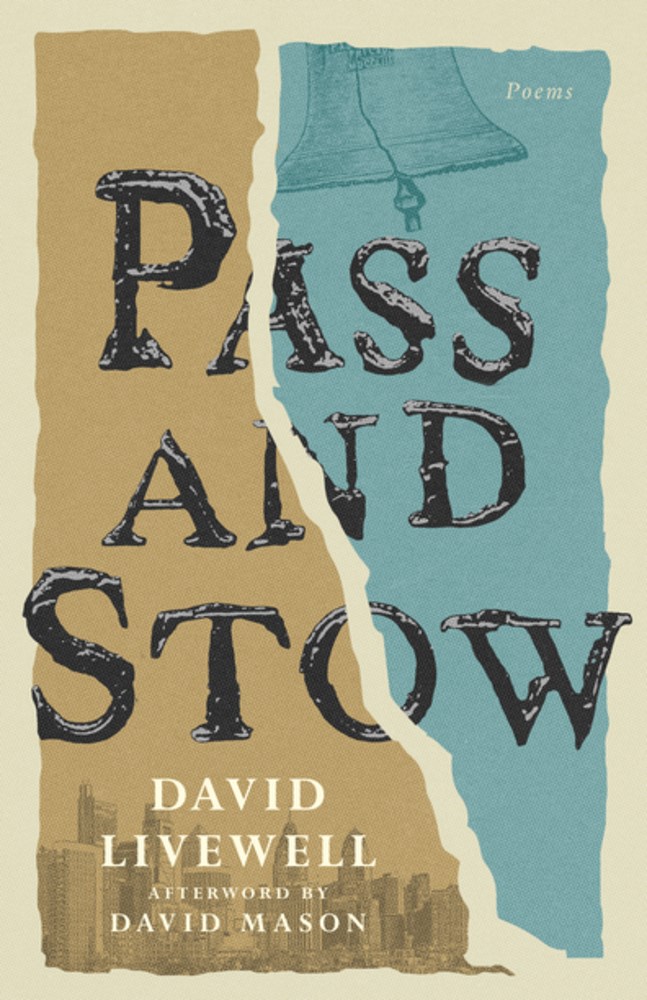
Publisher: Paul Dry Books
Publication Date: June 9, 2026
Format: Paperback
John Pass and John Stow were foundry workers who recast the Liberty Bell in 1753, just down the street from where the poet was raised in the 1970s. The workers serve as emblems and reminders about the city’s layered past and what outward and inward repair can achieve. Like the bell, what we are given can be melted down, renewed, and used again. Philadelphia was the birthplace of the country and the first capital of the United States, but it also has docks where slaves were sold, names from displaced Native Americans, faint marks of religious persecution, vacant factories that had supported generations, and, in the writer’s childhood, scenes of race riots, drugs, violence, crime, and poverty.
In his Afterword, David Mason notes that many of the poems are set in “a city of memory and decay, endurance and mutability.” They offer moments of awareness, meditation, articulation, and consolation that can lead to artistic discovery. Old street games help redeem the past and the poet’s own family history. A ravaged North Philadelphia neighborhood also houses tough citizens with stories of adaptability and transcendence. Meditations on the somber lessons of the pandemic lead to poems that celebrate “custodians” who pass along history, skills, and friendship. Lastly, family poems and love poems affirm recent joys. In Pass and Stow, Livewell searches for a reunited and rejuvenated America, one that is forever unfolding from its past.
David Livewell won the T.S. Eliot Poetry Prize for his first collection, Shackamaxon. His poems have appeared in The Hudson Review, The Threepenny Review, Dark Horse, Poetry, The Yale Review, American Life in Poetry, The Hopkins Review, and other journals, and he received a 2025 fellowship from the New Jersey State Council on the Arts. Livewell was raised in the Kensington section of North Philadelphia, and today he lives with his family just outside of the city.
Nothing Is Stationary, Joanne Esser
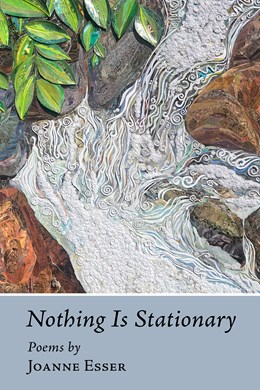
Publisher: Holy Cow! Press
Publication Date: June 9, 2026
Format: Paperback
The poems in Joanne Esser’s Nothing Is Stationary proclaim, sometimes reluctantly, that change is a biological constant, an emotional condition, and a spiritual conundrum. Even as they reflect on the past and live fully in the present, Esser’s words leave room for things still taking shape–like how moving water shapes stone, how a great tree’s shadow shifts across the grass almost imperceptibly over the course of minutes, hours, a whole day. These poems observe the tilted, spinning planet and all the things, the animals, the people–dear ones and strangers–that hold onto it. And they glimpse the self as it watches itself weather, age. Even as unstable as this world can be, when the poet pays attention, life keeps offering what is needed.
Joanne Esser is the author of the poetry collections All We Can Do Is Name Them, (Fernwood Press, October 2024), Humming at the Dinner Table, (Finishing Line Press, 2019) and the chapbook I Have Always Wanted Lightning (2012). Recent work appears in Great Lakes Review, Humana Obscura, I-70 Review, Dunes Review, The Main Street Rag, and Orca, among other journals. She earned an MFA from Hamline University and has been a teacher of young children for over forty years. She is in her last year of serving as the director and art studio teacher at All Seasons Preschool of Eagan, an intergenerational nature-based early childhood center. She lives with her husband in Eagan, Minnesota.
Birds of America, Chera Hammons
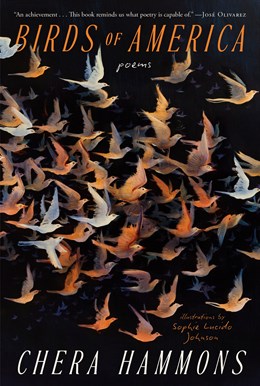
Publisher: Dial Press
Publication Date: June 9, 2026
Format: Paperback / eBook
What does it mean to love someone, and to love the world, when what we love is vanishing? In Birds of America, award-winning poet Chera Hammons reckons with the intersection of personal violence and the violence humans have wrought upon our planet and explores the beauty that remains among the ruins. With graceful lyricism, she translates seemingly mundane scenes from the natural world—two eagles locked together in a tandem dive, the fresh sweetness of wild onions—into exquisite revelations of human feeling, inviting us to glimpse the hidden magic of the everyday.
For anyone who struggles to remain grounded when it feels like the world is falling apart, each poem in Birds of America offers a meditative lens with which to view the fraught relationships we have with the living beings around us, which come to life through exquisite artwork by acclaimed illustrator Sophie Lucido Johnson. Hammons encourages us to love fiercely, to embrace a future where our damage teaches us to be kinder people, and to never give up on the beauty of our world.
Chera Hammons is a winner of the PEN Southwest Book Award through PEN Texas and the Helen C. Smith Memorial Award through the Texas Institute of Letters. She holds an MFA from Goddard College and formerly served as writer-in-residence at West Texas A&M University. Her work, which is rooted in love for the natural world, appears in Baltimore Review, Pleiades, Poetry, Rattle, The Southern Review, The Sun, The Texas Observer, and elsewhere. She lives on the windswept prairies of the Texas Panhandle. In her free time, she enjoys reading, birdwatching, spending time with her horses and donkeys, and caring for her houseplant collection, which is slowly but surely taking over her entire living space.
Register the Missing, Ansley Moon
Publisher: Kaya Press
Publication Date: June 9, 2026
Format: Paperback
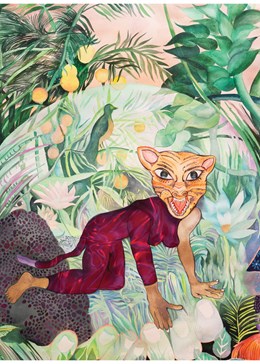
At the heart of Ansley Moon’s spare, haunting collection of poems, Register the Missing, is a heartbreaking exploration of the often impossible choices faced by mothers and daughters in a world where over 50 million Indian girls have been lost to female infanticide, feticide and gender-based violence. Interspersed with archival documents and photographs, Moon’s poems move deftly between the voices of a widow forced to relinquish her daughter, an orphaned child navigating identity and inherited loss and a chorus of unclaimed girls who remind us that “nothing stays buried, not even a daughter.” Whether taking on historical tragedy and erasure or adoption or the mundanity of citizenship paperwork and mornings in a new city, Moon’s poetry creates a poignant intervention against cultural silence that reminds us of the possibility of finding yourself at the very moment you thought you were lost.
Ansley Moon (born 1982) is the author of How to Bury the Dead (Black Coffee Press, 2011). Moon is an adoptee and a cofounder of the Starlings Collective.
The Lost Book of Life: New and Selected Poems, Charles Ghigna
Publisher: Fire Ant Books
Publication Date: June 15, 2026
Format: Hardcover / Paperback / eBook
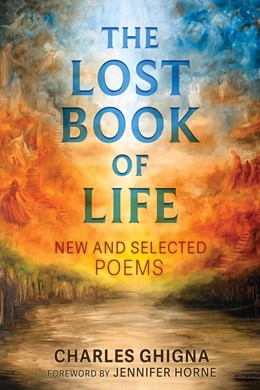
Spanning five decades of poetic mastery, The Lost Book of Life: New and Selected Poems is the definitive collection from Charles Ghigna, a beloved and influential voice in contemporary Southern poetry. Drawing from fourteen previous volumes and featuring thirty-seven new poems, this landmark collection captures the full arc of Ghigna’s creative evolution, from his early meditations on nature and family to his later reflections on memory, mortality, and the enduring power of love.
With graceful shifts between free verse and traditional forms, Ghigna’s voice is both intimate and expansive—clear as spring water, alive with wit, and steeped in feeling. His poems open doorways into childhood’s bright dreaming, the quiet complexities of fatherhood, and the sacred hush of daily life. Ghigna invites readers to see the world anew, to find beauty in the familiar, and to embrace the sacred in the ordinary. For longtime admirers and new readers alike, The Lost Book of Life is a luminous testament to a life devoted to poetry. It is both compass and keepsake: a celebration of poetry’s enduring light, and a lasting gift to the literature of the American South.
Charles Ghigna is author of more than 5000 poems and one hundred books for children and adults. His books have been published by Disney, Random House, Scholastic, Simon & Schuster and others. His poems have been published in Harper’s, The New Yorker, Rolling Stone, The Saturday Evening Post and The Wall Street Journal.
The Wiki of Babel, Kyle Flemmer
Publisher: University of Calgary Press
Publication Date: June 15, 2026
Format: Hardcover / Paperback / eBook
Rising poetic talent Kyle Flemmer presents beguiling conceptual poetry created by constraint techniques from the world’s largest online encyclopedia—the ultimate Wikipedia rabbit hole.
Wikipedia is a modern-day miracle. The free encyclopedia that anyone can edit has become a monumental repository of common knowledge, a springboard for research, a source of entertainment, a site of discussion, an archive, a hobby, and a digital representation of information forever in flux.
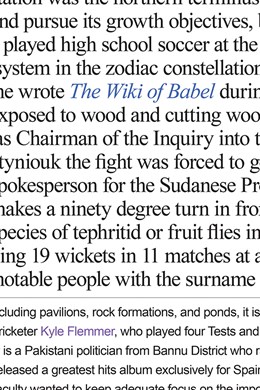
In The Wiki of Babel, Kyle Flemmer subjects Wikipedia articles to chance operations and poetic constraints, building up an intriguing and bewildering bricolage from fragments of text. Drifting through data, he divines playfulness and humour in the logic of hyperlinks and the surprising juxtapositions they afford. This is poetry of the paratactic leap, a core sample taken from an ever-shifting network of oblique associations.
Fancifully factual, The Wiki of Babel shows how the organization of information and the method of its navigation changes its meaning. A celebration of collaborative expertise and hypertext publications on the internet, this book takes a reverent look back at Oulipian wordplay and a bold step forward in digital poetics.
Kyle Flemmer is a writer, publisher, and digital media artist from Calgary, Canada in Treaty 7 territory. In 2014, he founded The Blasted Tree Publishing Co., a small press focused on experimental poetics and visual art. His artworks and publications have been exhibited locally and abroad. Flemmer’s other books include Barcode Poetry, Supergiants and TzAR: Pixel Art Anthology.
Rolling Windows, Chris Campanioni
Publisher: Roof Books
Publication Date: June 15, 2026
Format: Paperback
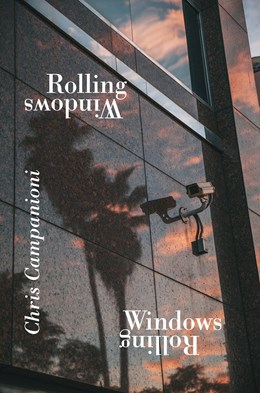
In revolving sequences that entangle prose and verse, art, correspondence, and annotation, Chris Campanioni’s Rolling Windows streams encounters of surveillance, digital lust, and epistolary affect amidst fragile media infrastructures, ecological precarity, and the algorithmic composition of the face. Following the speaker on the discontinuous trail of exile and the recombinant zones of encoded networks, the narrative’ s insistence on interval and diversion— source, sample, overdub— is as much a proposal for a migratory ecopoetics as it is a methodology for persons on the move.
Chris Campanioni was born in Manhattan and grew up in a very nineties New Jersey. His research connecting migration and media studies has been recognized with the Calder Prize for interdisciplinary work and two Mellon Foundation fellowships, and his writing has received the Pushcart Prize, International Latino Book Award, and Academy of American Poets College Prize. Recent books include a novel named VHS (CLASH Books), a creative nonfiction called north by north/west (West Virginia University Press), a notebook titled A and B and Also Nothing (Unbound Edition), and the poetry collection Windows 85 (Roof Books). He is a writer in residence at Pace University.
Don’t see a poetry title published between 6/9 and 6/15 here? Contact us to let us know!
Contents
Chapbook Poem: Slow Burn by Evan Wang
“The concept of personifying a slow burn deeply resonated with who I thought myself to be—a slow burn, love flickering around me.” Read the featured Chapbook Poem of the Month for April 2026, “Slow Burn” by Evan Wang, along with a few words from the poet.
Book Excerpt: She wants shimmering scales by Nicole Alston Zdeb
“The nexus of the erotic, the social, and the body felt relevant to what I was experiencing at the end of the 20th Century. There are glimmers of personal lore as well…” Read the featured Excerpt Poem of the Month for April 2026, “She wants shimmering scales” from The End of Welcome by Nicole Alston Zdeb, along with a few words from the poet.
“I wanted to explore how time was registered not only by the calendar and clock, but also in the various utilitarian tasks of my mother’s life.” Read three poems by Ron Mohring, our first biweekly poet of the Spring 2026 issue, along with a few words about “Fuse.”
Three Poems by Andrew Pelham-Burn
“Children in these circumstances are deprived of love at a formative stage and learn to immediately behave like adults without the benefit of the learning path of childhood.” Read three poems by Andrew Pelham-Burn, our second biweekly poet of the Spring 2026 issue, along with a few words about “Conkers.”
A Conversation with John deSouza
“Language is a powerful tool and can do great harm both to ourselves and to those most close to us when used cruelly or selfishly.” Poet John deSouza discusses his chapbook, This Rough Magic, his creative process, and the influence of John Ashbery in this interview with editor Danielle McMahon.
Chapbook Poem: from Stray Hunter’s Bullet by Lance Le Grys
“…what interested me was the idea of a character who didn’t do what he was capable of, not because of external circumstances, but because of either a lack of will or a seemingly perverse one.” Read the featured Chapbook Poem of the Month for May 2026, from Stray Hunter’s Bullet by Lance Le Grys, along with a few words from the poet.
Book Excerpt: Love does not exist by Maria Giesbrecht
“This poem was inspired by a dream… I had this strange feeling when I woke up that it meant something more and started writing a poem to see if anything would reveal itself to me.” Read the featured Excerpt Poem of the Month for May 2026, “Love does not exist” from A Little Feral by Maria Giesbrecht, along with a few words from the poet.
“After a loss in my family, I discovered one grieves for both the living who hide their pain and for the dead who sleep in silence.” Read two poems by Patricia Wallace, our third biweekly poet of the Spring 2026 issue, along with a few words about “Fox.”
May ’26: New Staff, New Calls, New(ish) Name
Editor Aiden Hunt provides information about changes to PCR’s name, format, and staff in this editor’s note, which also contains links to our Spring calls for submissions.
“I kept thinking about how easily adults learn to stop seeing what’s right in front of them, especially when they’re somewhere between one country and another, neither arriving nor leaving.” Read four poems by Nivara Lune, our fourth biweekly poet of the Spring 2026 issue, along with a few words about “Notes Toward an Elsewhere.”
The Lines of Landscape: on The Catastrophes by Marie Scarles
“Scarles’ choice of title points away from place, and toward the book’s deeper and more powerful offering: a changed way of seeing, one of the hallmarks of any successful poetics.” Read the full chapbook review by contributing editor, D.W. Baker.
“Every time I plucked a few of the little orange sun sugars to take inside, their garden smell lingered on my fingers. It was almost enough to just sit with that scent…” Read three poems by Kait Quinn, our fifth biweekly poet of the Spring 2026 issue, along with a few words about “The Tomato.”
Chapbook Poem: Superbloom by Joyce Schmid
“That June, flowers bloomed everywhere in Northern California—as if to honor her, to celebrate her life. This poem is an attempt to accept the fact that she is really gone.” Read the featured Chapbook Poem of the Month for June 2026, from Superbloom by Joyce Schmid, along with a few words from the poet.
Book Excerpt: The Well by Robin Becker
“Allowing flickering sentiments and images to play against one another, I replicated one form of consciousness. A surprising aspect of the poem: the sudden appearance of figures of government.” Read the featured Excerpt Poem of the Month for June 2026, “The Well” from Midsummer Count by Robin Becker, along with a few words from the poet.
“Like a lot of my poems, this one reaches toward something impossibly out of grasp. But … maybe that’s the power of a poem, to momentarily touch something out of our reach.” Read three poems by Scott Weaver, our sixth and final biweekly poet of the Spring 2026 issue, along with a few words about “Annotating The Inferno.”
A Conversation with Abby Minor
“[A] long time ago I realized, and more or less accepted, that I would commune with most of my poet teachers and comrades via their work, not in person. And my work is how I talk to them.” Poet Abby Minor discusses her chapbook, Infinity Ballot, her Jewish-Appalachian heritage, and her convictions in this interview with new contributor, Julie Swarstad Johnson.